

RevFlow AI turns fragmented sales workflows into an always-on revenue operations engine

AblyCode designed a multi-agent revenue operations platform that helps B2B sales teams qualify leads faster, prepare account context instantly, automate follow-ups, and surface pipeline risk before it hurts forecast accuracy. Built as an AI-native platform, RevFlow AI combines role-specific agents, human approvals, CRM sync, activity intelligence, and analytics in one operating layer for modern go-to-market teams.
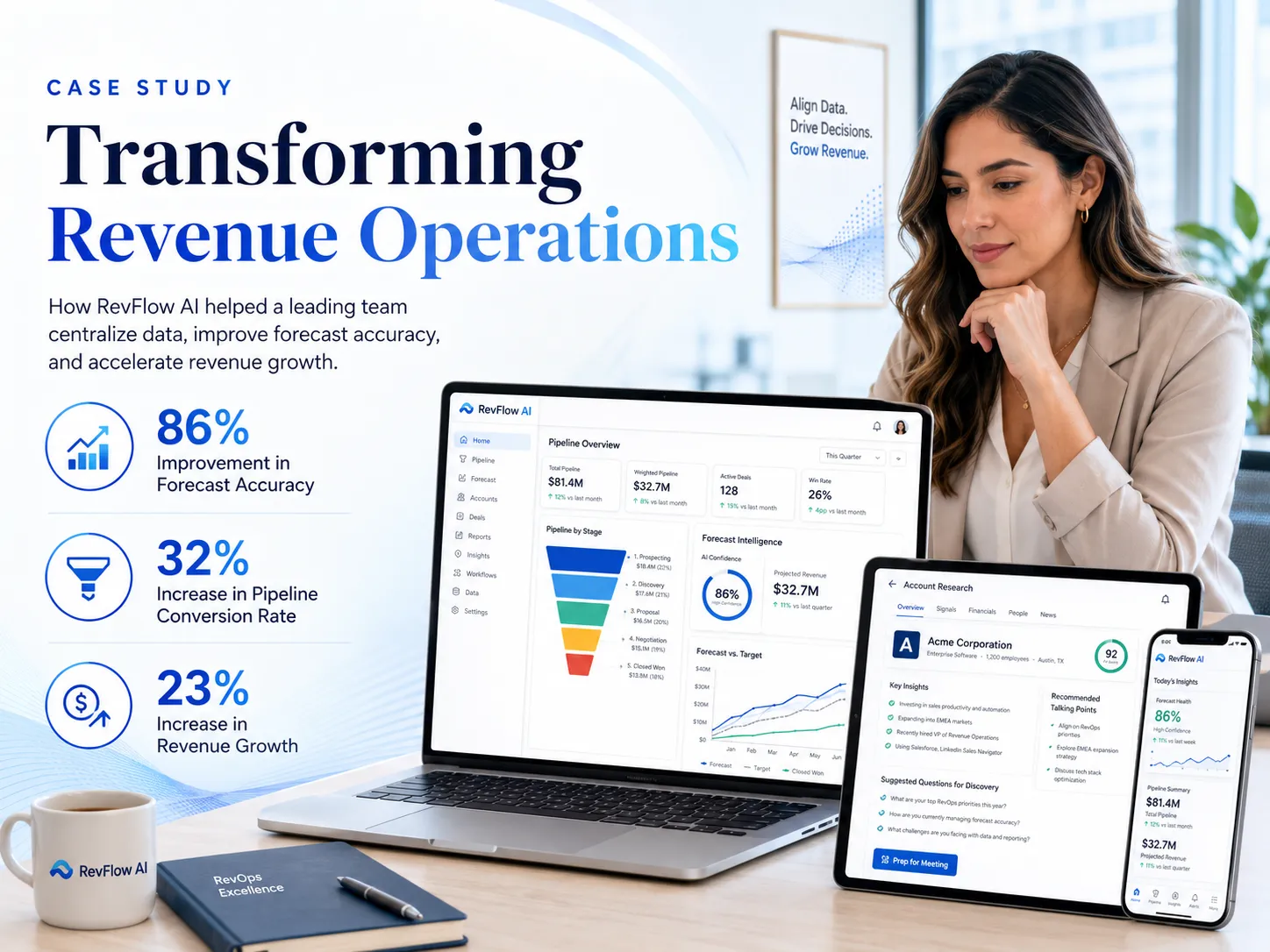
RevFlow AI Screenshot 1RevFlow AI Screenshot 2RevFlow AI Screenshot 3
Industry
SaaS / B2B Revenue Operations
Services
Technology consulting
Product strategy
UI/UX design
Software engineering
AI integration
Cloud / DevOps
QA services
Application management
Team
Product strategist
Lead engineer
AI engineer
Full-stack developers
UI/UX designer
QA engineer
DevOps engineer
Results
Faster lead qualification, cleaner CRM hygiene, better follow-up consistency, and earlier visibility into deal risk across the pipeline.

AblyCode helped us move from disconnected tools and manual follow-ups to a much more structured revenue workflow. What stood out was their ability to combine strong engineering with a clear understanding of how sales and RevOps teams actually work day to day.

Chief Revenue Officer

About RevFlow AI: a multi-agent operating layer for revenue teams

Revenue teams usually work across disconnected tools: CRM, call recording, email, calendars, spreadsheets, sales engagement tools, internal knowledge bases, and Slack. The result is familiar: reps spend too much time updating systems, managers struggle to trust pipeline data, and operations teams patch the gaps manually.
RevFlow AI was imagined as a response to that problem. Instead of adding another dashboard on top of an already crowded stack, the platform acts as a revenue operations layer powered by specialized AI agents. Each agent handles a narrow responsibility — qualifying inbound leads, preparing account briefs, drafting follow-ups, flagging pipeline risk, and syncing approved actions back to core systems.
Human teams remain in control, but repetitive work gets compressed dramatically. The result is a system that helps revenue organizations move faster without losing governance, visibility, or quality.

RevFlow AI x AblyCode: what the platform includes

Over time, AblyCode would shape RevFlow AI as a modular platform with user-facing workspaces, agent workflows, manager controls, and integration infrastructure that fits into a modern B2B sales stack.

Milestone 1:
AI Lead Qualification Console

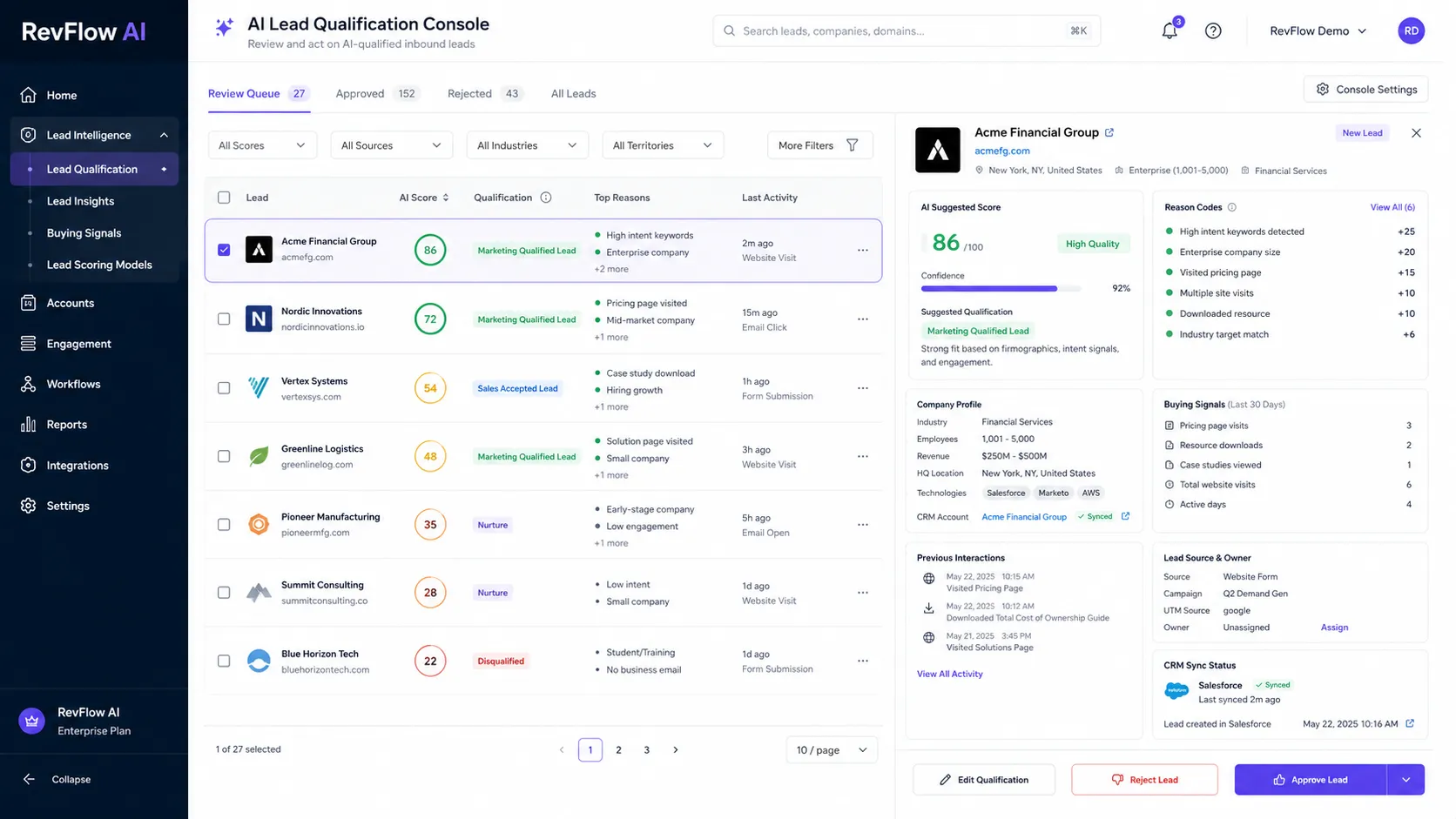
The first layer of the platform helps inbound and outbound teams assess lead quality faster and more consistently. When a new lead enters the system, the qualification agent enriches the account, inspects firmographic signals, checks activity context, and drafts an initial lead score with reason codes.
Faster speed-to-first-touch for new leads, more consistent scoring across reps, lower manual data-entry burden for SDR teams
What we did:
Designed a lead qualification workspace where sales and SDR teams can review AI-scored leads in a structured queue
Built agent workflows to combine CRM fields, website signals, previous interactions, and enrichment data into a unified lead profile
Added approval controls so teams can accept, edit, or reject AI-proposed qualification outcomes
Created reason-based scoring explanations and synced approved outcomes back into the CRM

Milestone 2:
Account Research and Meeting Prep Agent

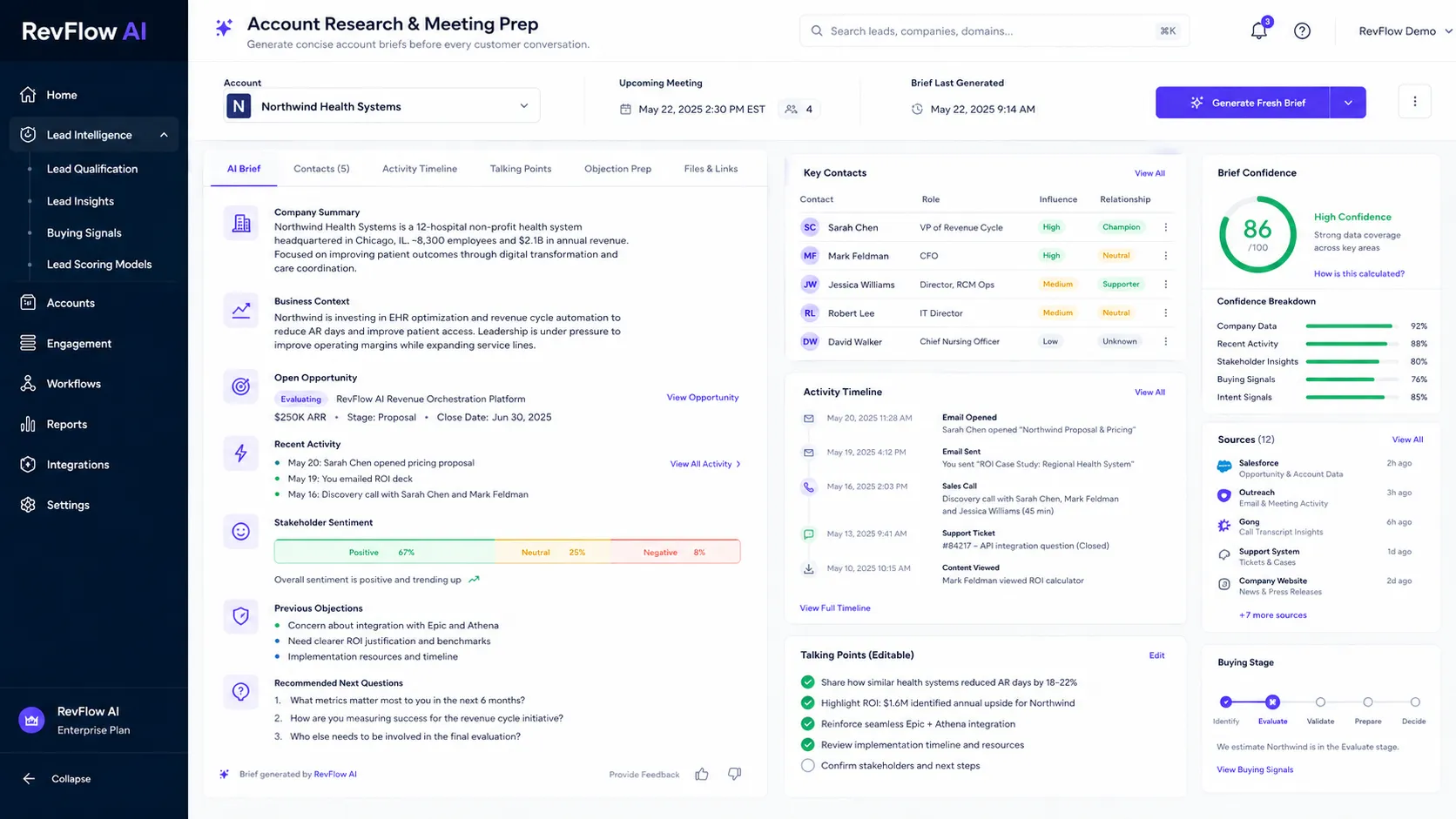
Before meetings, the platform assembles a concise account brief: company context, recent activity, key contacts, previous objections, open opportunities, stakeholder sentiment, and recommended next questions.
Less pre-meeting preparation time, better rep consistency in discovery and follow-up, stronger continuity across multi-threaded accounts
What we did:
Designed a meeting prep experience that generates structured account briefs in seconds
Built retrieval pipelines that combine CRM records, call notes, previous emails, support context, and internal knowledge articles
Added role-aware brief generation and introduced editable AI-generated talking points, objection handling prompts, and a confidence and sources panel

Milestone 3:
Follow-up Automation with Human Approval

RevFlow AI addresses follow-up pain with a follow-up agent that drafts context-aware emails, summarizes calls, proposes next actions, and recommends task creation based on sales stage and buyer intent.
Higher follow-up consistency, reduced rep admin work after meetings, better conversion from meeting to next-step commitment
What we did:
Designed a follow-up approval inbox where reps can review, edit, approve, or discard AI-generated outreach
Built contextual draft generation using call summaries, opportunity stage, stakeholder history, and product interest signals
Added configurable automation rules by segment, deal size, lifecycle stage, and sales motion
Created guardrails for tone, prohibited claims, and escalation scenarios, and synced approved emails back to CRM

Milestone 4:
Pipeline Risk Detection and Forecast Intelligence

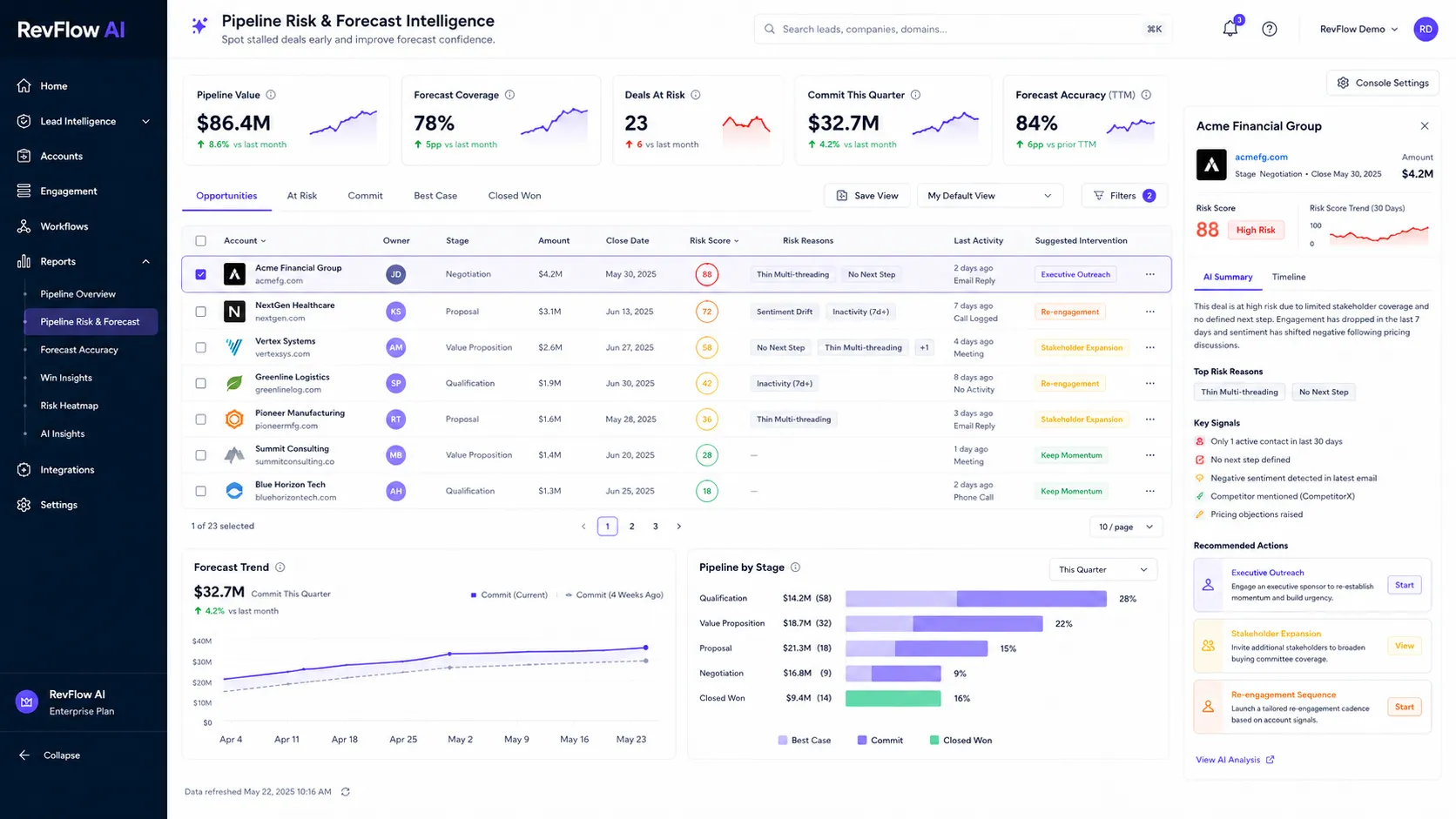
Forecasting usually breaks when managers spot risk too late. RevFlow AI adds an early-warning layer that detects stalled deals, thin multi-threading, sentiment drift, missing stakeholder engagement, and weak next-step discipline.
Earlier identification of at-risk deals, better coaching visibility for managers, more credible forecast conversations across teams
What we did:
Designed a pipeline command center with risk scoring, forecast views, and account-level drilldowns
Built a risk engine that combines deal progression, communication patterns, meeting outcomes, and inactivity thresholds
Added explainable risk signals so managers can see why a deal is being flagged
Created intervention workflows that suggest specific actions such as executive outreach, re-engagement, or stakeholder expansion

Milestone 5:
Revenue Ops Admin and Agent Governance Layer

The platform becomes truly enterprise-ready when operations teams can configure it without engineering involvement every week. This layer gives revenue operations and platform admins control over prompts, workflow rules, approval thresholds, and audit trails.
Lower dependency on engineers for day-to-day workflow changes, safer rollout of AI features, better governance for enterprise sales environments
What we did:
Built an admin console for agent policies, approval rules, and workflow configuration
Added prompt versioning and test environments for safe changes to AI behavior
Created mapping controls for CRM objects, lifecycle stages, activity schemas, and designed audit logs for every AI recommendation and approval action

AblyCode’s engineering standards applied inside RevFlow AI

We approached the platform as an AI-native enterprise product, not as a chatbot bolted onto a dashboard. That means agent orchestration, approvals, observability, integration reliability, and user trust all matter as much as the model itself.
1

Human-in-the-loop by default

Not every AI suggestion should become a system action automatically. We designed the platform so qualification updates, CRM writes, follow-ups, and escalations can be routed through configurable review layers based on deal size, risk, or workflow type.

2

Explainability built into the interface

Revenue teams will not trust black-box scoring. The platform exposes why a recommendation was made, what data informed it, and how confident the system is. This improves adoption and makes coaching easier.

3

Multi-agent orchestration, not one giant assistant

We separated responsibilities across focused agents: qualification, account research, follow-up drafting, risk analysis, and admin policy enforcement. That keeps workflows easier to test, govern, and scale.

4

Integration-first architecture and cloud-native reliability

A revenue platform only works when it fits the existing stack. We designed the system to connect with CRM, calendar, email, call intelligence, knowledge bases, and messaging tools. The platform was conceived for high daily activity volumes, with event-driven workflows, queue-based task execution, retries, monitoring, and role-based security built in from the start.


Their [AblyCode] focus on ownership, product thinking, and execution pace was critical to shaping the platform. They understood both the workflow complexity and the operational realities of our revenue team, and translated that into a product that felt practical, scalable, and enterprise-ready.

Chief Revenue Officer

What the product experience looks like

The user experience is designed around action, not just visibility. A rep opens the dashboard and sees which leads need review, which opportunities are stalling, what follow-ups are waiting for approval, and what meetings need prep.
A manager sees team-level risk, forecast shifts, and rep execution patterns. Operations sees integration health, prompt versions, workflow outcomes, and configuration controls. Each role gets a different control surface, but all of them work from the same operational system.

Value delivered

Better rep productivity

Revenue teams spend less time updating records, gathering context, and rewriting the same follow-up messages. More energy shifts toward actual selling.
Faster lead qualification
Cleaner CRM hygiene
Better follow-up consistency

Cleaner operational data

Because approved AI actions sync back into the CRM in a controlled way, pipeline hygiene improves instead of decaying under manual entry fatigue.

Enterprise-ready AI adoption

The platform demonstrates how AI can be introduced into revenue operations with governance, auditability, explainability, and role-based control. As the team grows, process consistency matters more. AI agents help standardize qualification, meeting prep, and follow-up without flattening human judgment.
Call to action background
Work with us on your next project