

ForgeOps AI: AI-powered production intelligence helps manufacturers cut downtime, predict delays, and improve execution on the shop floor

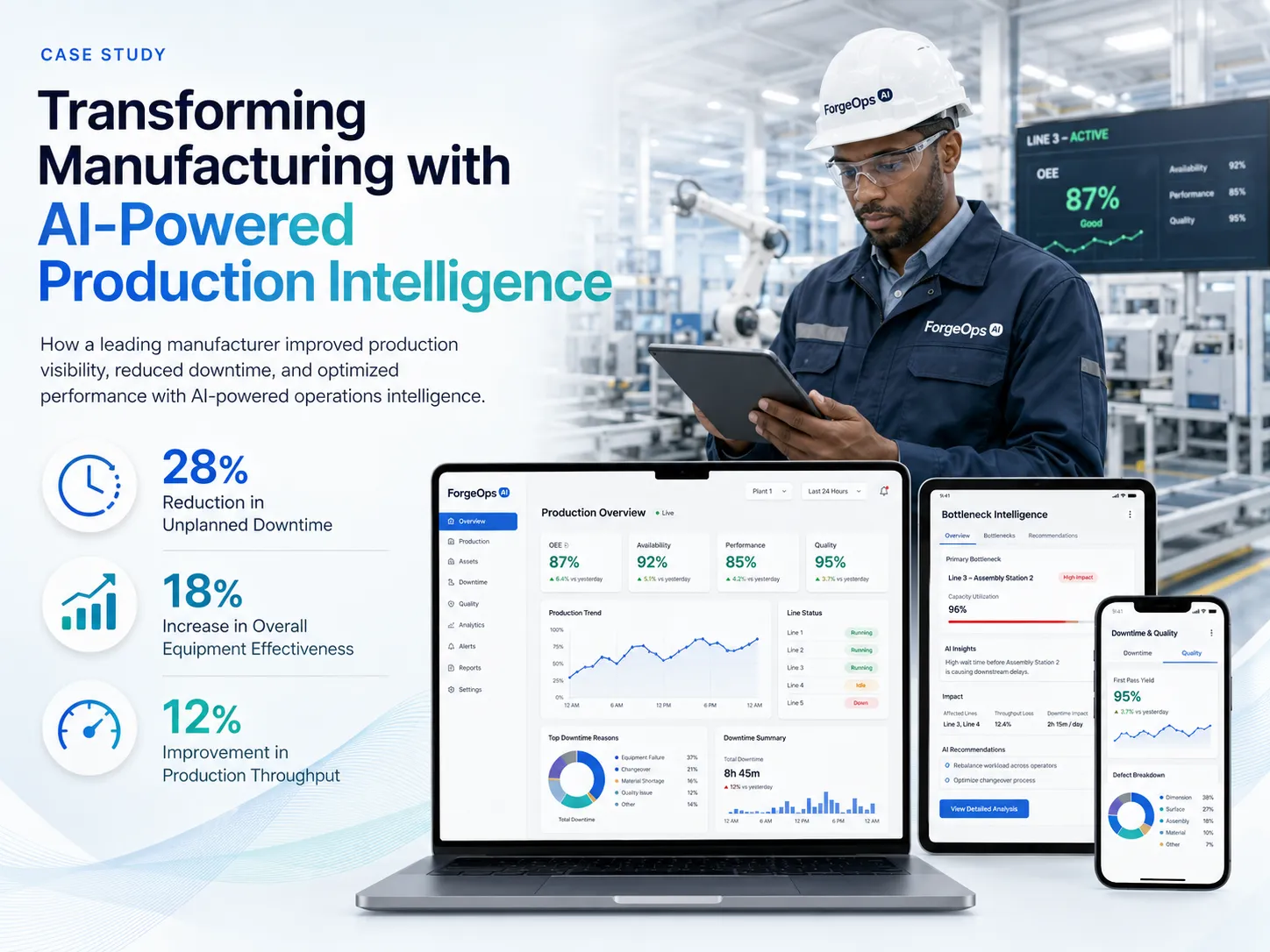
ForgeOps AI is a conceptual manufacturing operations platform designed for factories that want to move beyond static dashboards and manual reporting. AblyCode designed it as an AI-native layer for production planning, machine monitoring, operator workflows, quality intelligence, and supervisor decision-making. By combining real-time shop-floor signals with ERP, MES, quality, and maintenance data, the platform helps manufacturing teams identify bottlenecks earlier, respond faster to disruptions, and make better production decisions with less manual coordination.
ForgeOps AI Screenshot 1ForgeOps AI Screenshot 2ForgeOps AI Screenshot 3
Industry
Manufacturing / Industrial Operations
Services
Technology consulting
AI solution design
UI/UX design
Software engineering
Data integration
Cloud / DevOps
QA services
Application management
Team
Business analyst
Lead engineer
AI engineer
Frontend and backend developers
Manufacturing workflow consultant
QA engineer
DevOps engineer
Results
Earlier visibility into production risk, lower manual reporting effort, better schedule reliability, and faster response to machine, quality, and workflow disruptions.

Their focus on ownership, execution pace, and practical problem-solving was critical in shaping the platform. They understood that manufacturing teams do not need abstract AI — they need systems that help planners, supervisors, and operators make better decisions under real production pressure.

Director of Digital Manufacturing

About ForgeOps AI: an AI operating layer for modern manufacturing

Manufacturing teams often work across disconnected systems: ERP for orders, spreadsheets for planning, machine interfaces for telemetry, paper or kiosk entries for operator updates, separate quality systems, and manual escalation through calls or messaging groups. That fragmentation creates predictable problems.
ForgeOps AI was imagined as a response to that gap. Instead of acting as just another dashboard, the platform becomes a production intelligence layer that sits across the factory existing systems. It combines live operational data, workflow events, quality signals — and historical production patterns to support planning, disruption response, and daily decision-making.
The goal is not to replace existing ERP or MES investments. The goal is to make the entire operation more visible, more responsive, and more intelligent.

ForgeOps AI x AblyCode: what the platform includes

Over time, AblyCode would shape ForgeOps AI as a modular manufacturing execution intelligence platform with role-based workspaces, data integrations, predictive models, and operational dashboards.

Milestone 1:
Live Production Visibility

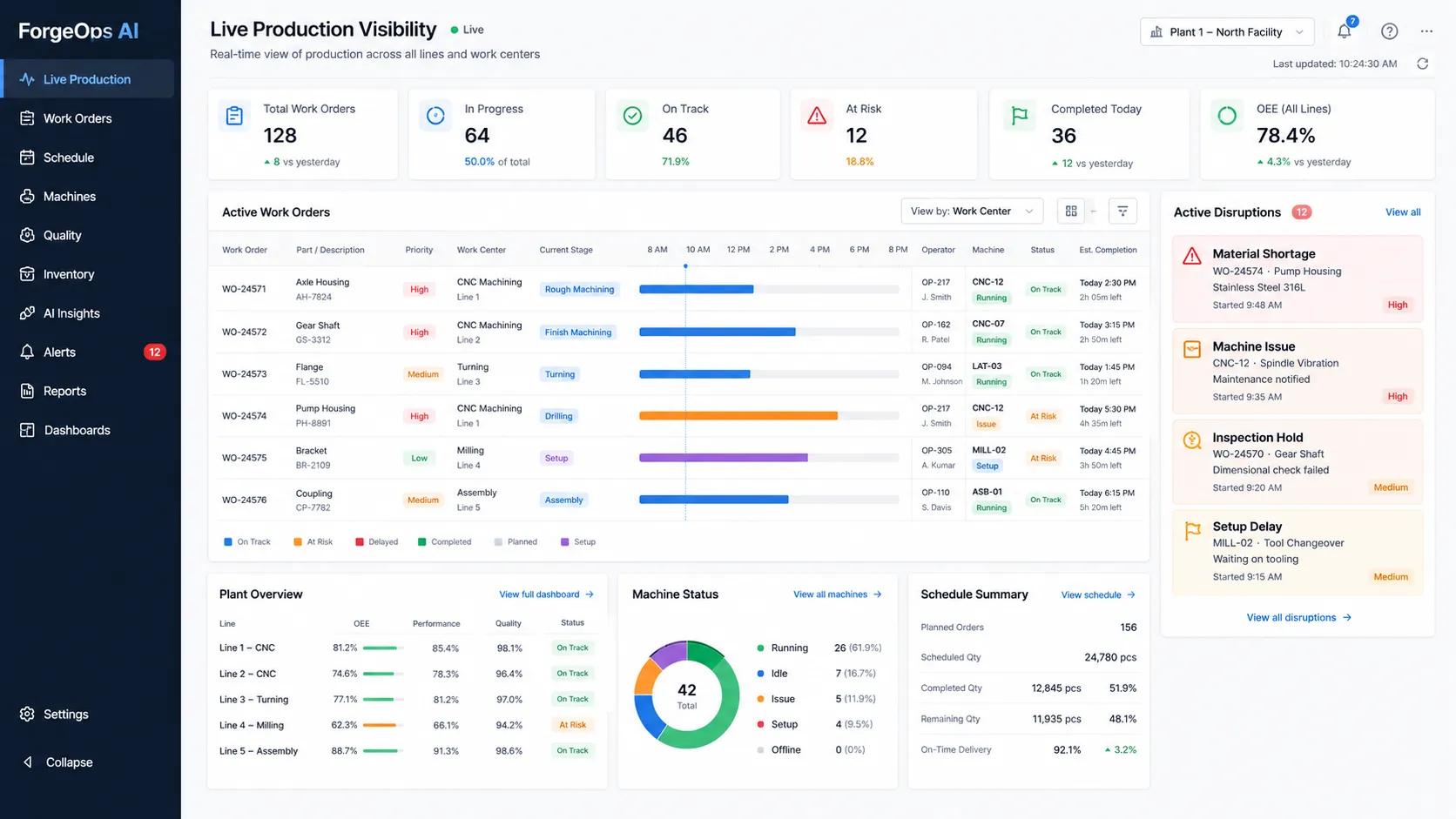
The first layer of the platform gives the plant a shared operational view. Instead of relying on scattered spreadsheets or isolated machine screens, ForgeOps AI presents a real-time production board showing active orders, current stages, operator assignments, disruptions, and expected completion.
A single operational surface where teams can see not only what is happening, but also where execution is beginning to drift
What we did:
Designed a live production dashboard for planners, supervisors, and plant managers
Created operator-facing execution screens to start work, pause for disruptions, record reasons, and complete stages
Built stage-level order tracking so each work order shows exactly where it is and what is blocking it
Added disruption logging workflows for machine issues, tooling waits, material shortage, and inspection hold

Milestone 2:
AI Delay Prediction and Bottleneck Intelligence

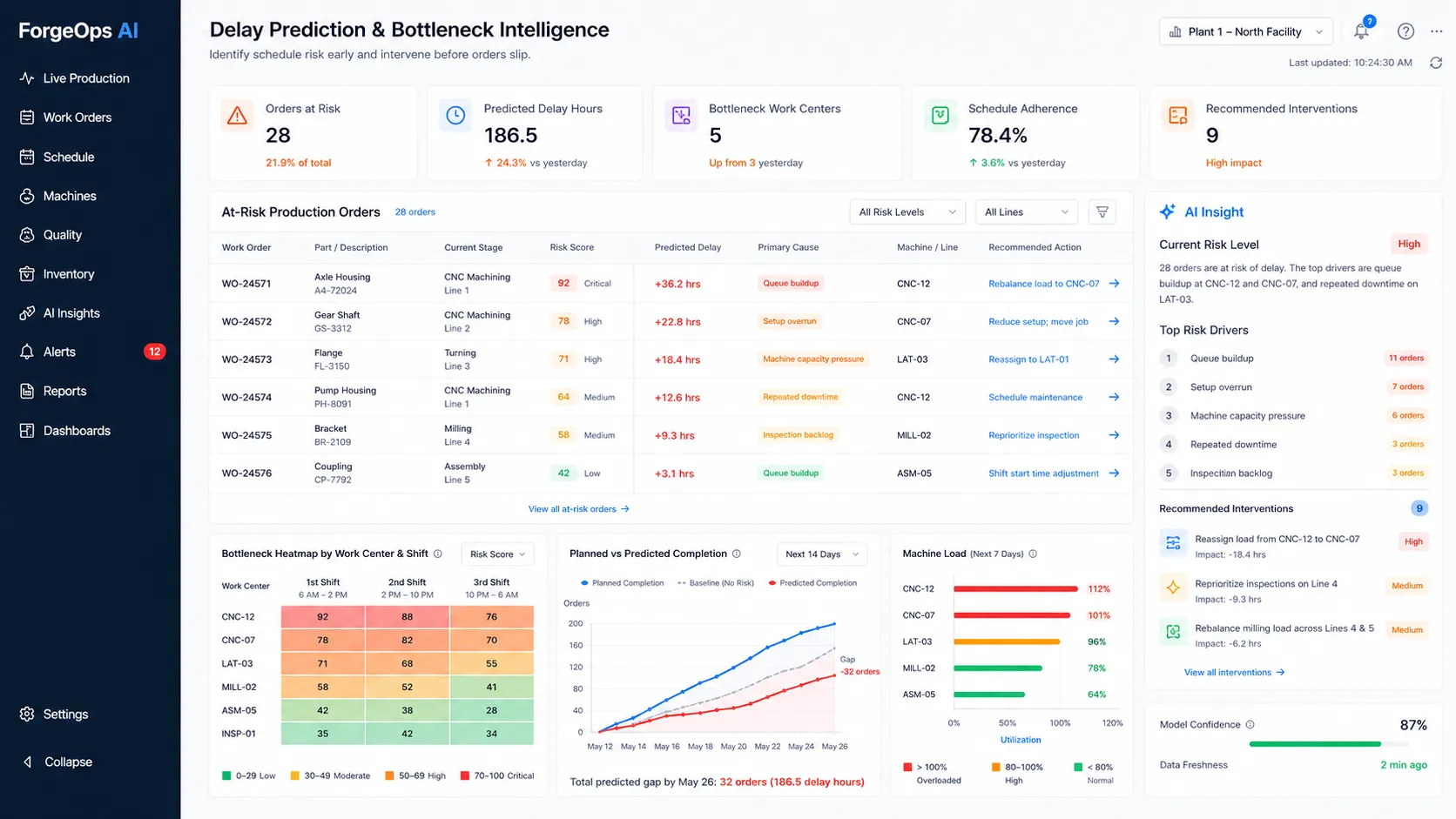
ForgeOps AI adds an AI-powered delay prediction layer that analyzes stage duration patterns, setup overruns, queue congestion, disruption history, and machine availability to forecast where a production plan is likely to slip.
Planners and supervisors get early warning before orders are already late, with practical reasons for schedule risk
What we did:
Designed a planning intelligence board that highlights orders at risk of delay
Built predictive workflows that analyze current execution data against historical patterns by stage, machine, operator, and order type
Added explainable risk signals and intervention suggestions such as reassigning machines, rebalancing stage load, or prioritizing inspection

Milestone 3:
AI Downtime Assistant and Disruption Intelligence

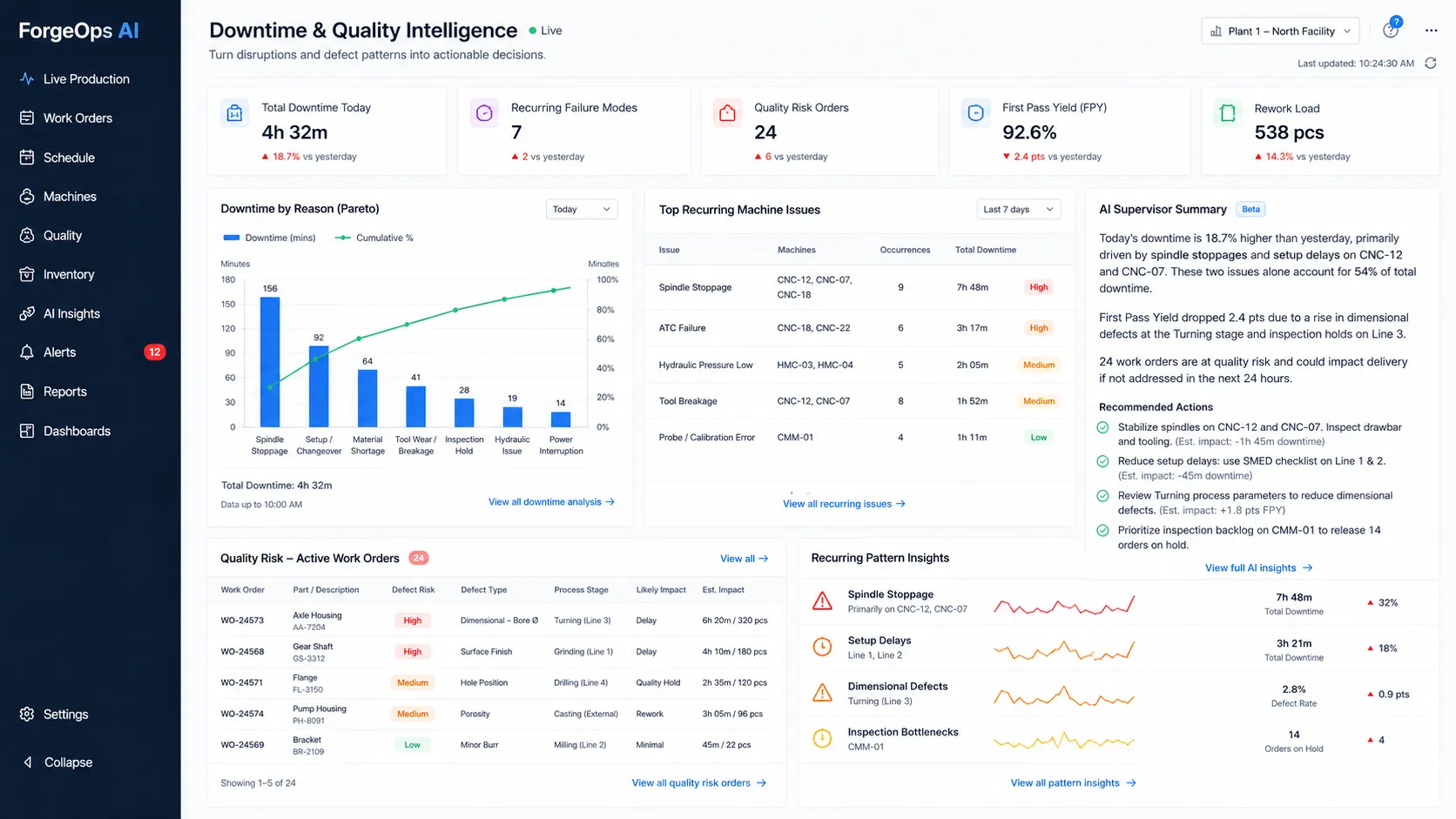
ForgeOps AI includes a downtime intelligence layer that classifies disruption patterns, groups similar events, highlights recurring failure modes, and helps maintenance and production teams identify the highest-cost causes of lost time.
Transforms downtime from a reporting artifact into a decision-support signal for supervisors and maintenance teams
What we did:
Designed a disruption analysis workspace showing downtime by machine, reason, shift, work center, and duration
Built AI classification support for ambiguous or inconsistently entered disruption reasons
Added recurring-pattern detection to identify repeated issues such as setup overrun, spindle stoppage, and tool change delays
Created a supervisor summary panel that explains current plant impact in plain language

Milestone 4:
Quality Risk and Anomaly Detection

ForgeOps AI adds a quality intelligence layer that helps teams identify recurring defects, detect anomaly patterns, trace rework load, and estimate which active orders may be at higher risk based on process behavior and inspection outcomes.
A more connected relationship between production and quality, where issues do not remain isolated until the end of the process
What we did:
Designed a quality risk dashboard that shows defect trends, rework clusters, and inspection bottlenecks
Built anomaly-detection workflows using production, inspection, and operator event signals
Added part-family and process-level views so quality teams can identify where risk is concentrating
Created AI-generated summaries for supervisors and planners, explaining likely quality-driven schedule impact

Milestone 5:
Supervisor and Planner Copilot Workflows

Dashboards are useful, but plant execution often depends on quick decisions made under time pressure. ForgeOps AI includes guided operational workspaces for supervisors and planners with AI-generated summaries, suggested actions, and the likely effects of different choices.
Operational decisions are supported by AI summaries and risk signals, reducing the effort needed to understand fast-changing plant conditions
What we did:
Designed role-based workspaces for planners, supervisors, quality leads, and plant managers
Built plain-language AI summaries that explain what changed, what is at risk, and what action is recommended
Added shift handover summaries and alerting panels for late risk, downtime escalation, material risk, and queue buildup

AblyCode’s engineering standards applied inside ForgeOps AI

We approached the platform as a real manufacturing operations product. That means explainability, human-in-the-loop decisions, role-based interfaces, and operational simplicity all matter as much as the AI models.
1

Explainability before automation

We prioritized explainable risk indicators and clear operational reasoning instead of hidden scoring models. If an order was predicted to slip, the system showed whether the cause was queue buildup, setup overrun, repeated downtime, or machine capacity pressure.

2

Human-in-the-loop decisions

The platform recommends and highlights, but supervisors and planners stay in control. AI is there to help teams act faster, not to make unreviewed plant decisions automatically.

3

Role-based interfaces

Operators, planners, supervisors, quality teams, and plant managers all need different views. We designed distinct surfaces for each role rather than forcing every user into one generic dashboard.

4

Operational simplicity

Factories are busy environments. The interface was designed to surface the next useful action quickly, not to overwhelm teams with analytics for its own sake.

What the product experience looks like

A supervisor opens the platform and immediately sees which orders are at risk, which machines have disruptions, what the AI recommends, and where bottlenecks are forming.
A planner sees schedule risk, delay predictions, and intervention options. Plant leadership sees shift progress, utilization trends, and quality patterns. Each role gets a different control surface, but everyone works from the same production intelligence system.

Value delivered

Earlier identification of bottlenecks

Production risk becomes visible before it becomes a delivery failure.
Better response to downtime
Improved decision-making
Stronger production-quality connection

Better planner and supervisor decisions

AI summaries and risk signals reduce the effort needed to understand fast-changing plant conditions.

A scalable foundation for AI in manufacturing

The platform provides a realistic, adoption-friendly path for using AI in daily factory operations.
Call to action background
Work with us on your next project