

When someone asks, "What will the ROI be?" they usually want certainty before they approve a budget.
That is understandable. Software is expensive, timelines move, and no one wants to sponsor an initiative that turns into a money sink.
But the uncomfortable truth is this: the ROI of custom software is rarely clear at the moment a project begins.
Not because ROI is a bad concept. And not because software teams are hiding something.
It is because early software estimates usually focus on the visible part of the investment: discovery, design, development, and launch. What changes the economics later is everything around the product after release. Stability, change requests, architecture decisions, support load, onboarding, compliance needs, scaling pressure, and the speed at which the product can evolve all influence whether the investment pays off.
That is why two projects with the same launch budget can produce completely different business outcomes a year later.
A lot of internal planning starts with one number: "What will it cost to build?"
That question matters, but it is incomplete.
The first version of a product is only the beginning of the spending curve. Once software enters the real world, new cost layers appear. Infrastructure becomes more serious. Testing becomes more consequential. Monitoring becomes necessary. Support requests arrive. Teams discover edge cases. Integrations behave differently in production than they did in staging. And every future enhancement depends on whether the original foundation was designed for change or merely for launch.
This is where many ROI calculations break down. They assume launch is the finish line when, in reality, launch is the point where long-term economics begin.
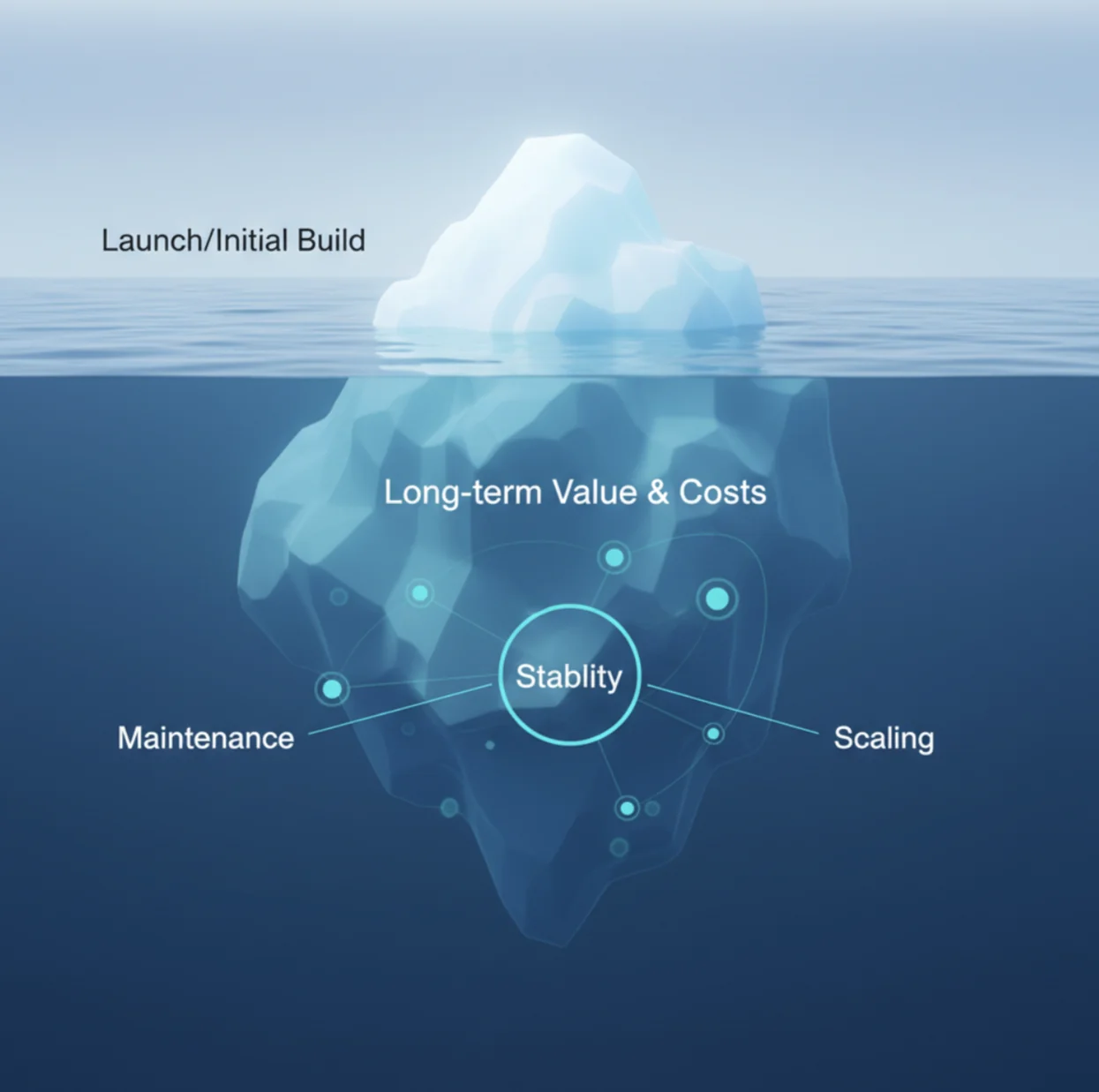
A working demo and a reliable production system are not the same thing. Real products need environments, deployment discipline, monitoring, security, backups, recovery planning, and room to scale. When these are treated as secondary, the business often pays later through outages, urgent fixes, or expensive platform changes.
Testing is not just a phase before release. It is a cost-control mechanism. Problems caught early are cheaper than problems discovered by users. Weak QA practices create a delayed bill: emergency fixes, reputation damage, team stress, and slowed delivery.
Every useful product attracts change. Users want improvements. Regulations change. Internal teams ask for new workflows. Third-party systems update their APIs. Bugs surface in situations nobody predicted. Maintenance is not a sign of failure. It is part of owning software. The real question is whether that maintenance will be structured and manageable or chaotic and expensive.
Software becomes expensive when knowledge lives only in people's heads. When context is missing, every change takes longer because the next team must first rediscover why earlier decisions were made. Clear documentation, architecture rationale, and handover discipline reduce this hidden tax.
A product does not become costly only because it grows. It becomes costly when every new step requires extra effort just to understand the system before changing it.
This often happens when delivery is split across disconnected parties. One team builds the first version. Another inherits support. Specialists enter later for QA, DevOps, integrations, or redesign work. On paper, this can look efficient. In practice, it often creates gaps in accountability and continuity.
Each handoff introduces friction. The new team needs time to learn the system. Earlier assumptions are no longer obvious. Tradeoffs made under deadline pressure now shape future work. Small feature requests take longer because the path to safe implementation is unclear. The business starts paying not only for progress, but also for recovery of lost context.
That is one reason leaders feel software ROI is hard to track. The spend is no longer tied cleanly to business improvement. Part of it now goes to navigating complexity that should have been prevented earlier.
Instead of asking, "What is the ROI of this software?" from day one, it is often more useful to ask three better questions:
How predictable will future change be?
A product that can be extended without major rework tends to create better economic outcomes than one that must be restructured every time priorities shift.
How much operational uncertainty are we accepting today?
Cutting corners can reduce the initial invoice, but it often increases future volatility. Lower upfront cost does not always mean lower total cost.
Will the system get easier or harder to evolve over time?
This may be the most important question of all. Strong software delivery creates compounding benefits: faster iteration, cleaner releases, and better decision-making. Weak delivery creates compounding friction.
Seen this way, ROI is not just a finance formula. It is a product of delivery quality, technical choices, and continuity of ownership.
The way software is delivered influences whether costs stay visible or become unpredictable.
When ownership is fragmented, it is easier for gaps to form between design, engineering, testing, deployment, and support. Responsibility gets diffused. The business absorbs the coordination burden. Future work becomes slower because no one fully owns the consequences of earlier decisions.
When ownership is continuous, decisions tend to be made with a longer horizon. Architecture is shaped with future change in mind. Testing is treated as part of delivery, not a last step. Operational readiness is considered earlier. The team is more likely to optimize for the life of the product, not just for the launch date.
That does not guarantee a lower budget. It does create a better chance of cost predictability.
And predictability is what makes ROI easier to manage.
You may never know the exact ROI of a software initiative on the day you approve it.
But you can create conditions that make ROI more believable over time.
It becomes easier to trust when:
In other words, ROI becomes easier to understand when the product is built in a way that reduces surprises.
The goal is not to produce a spreadsheet that pretends to predict every benefit and every cost in advance.
The goal is to make smarter decisions about how software is planned, delivered, and evolved.
A simple ROI formula can still be useful at a high level. But leaders should be careful not to mistake a neat early estimate for true economic clarity.
In software, the bigger question is not only "What will this cost to build?"
It is also:
That is where the real economics of custom software live.