

When companies need software built, the first instinct is often to ask one practical question:
Do we build internally or bring in outside help?
That sounds like the right place to start, but it is usually not the most important decision.
The more important question is this:
Do we want external people to supply capacity, or do we want a partner to own delivery from end to end?
That difference shapes almost everything that follows. It affects execution speed, quality, visibility, accountability, product consistency, and how expensive the software becomes to evolve over time.
For many tech leaders, that is the real divide between a staffing-style outsourcing model and a full-cycle development model.
Most software projects do not fail because teams cannot write code.
They struggle because delivery breaks down between stages.
Strategy is separated from execution. Design decisions are made without technical context. Engineering pushes features forward without enough product clarity. QA arrives too late. Infrastructure is treated as an afterthought. Ownership gets blurry once the first release ships.
From the outside, these issues look like delays, budget overruns, and inconsistent quality. But underneath, the pattern is simpler: too many gaps, and not enough true accountability.
This is why many leaders become frustrated with traditional outsourcing arrangements. They may get access to developers, but still end up carrying the hardest burdens themselves: direction, coordination, prioritization, quality pressure, and cross-team alignment.
In other words, they outsource labor but retain risk.
There are many variations in the market, but most software partnerships fall into one of two broad models.
In this structure, the vendor gives you people. You guide the work.
That can be effective when you already have strong product leadership, mature engineering practices, clear priorities, and the internal capacity to manage an external team closely. The outside team extends your bench, but your organization still owns the system of delivery.
This model gives you more direct control. It also gives you more responsibility.
If priorities drift, if requirements are weak, if the backlog is unstable, or if decisions are delayed, the project suffers whether the engineers are talented or not.
In a full-cycle model, the partner takes responsibility for the broader execution path, not just implementation tasks.
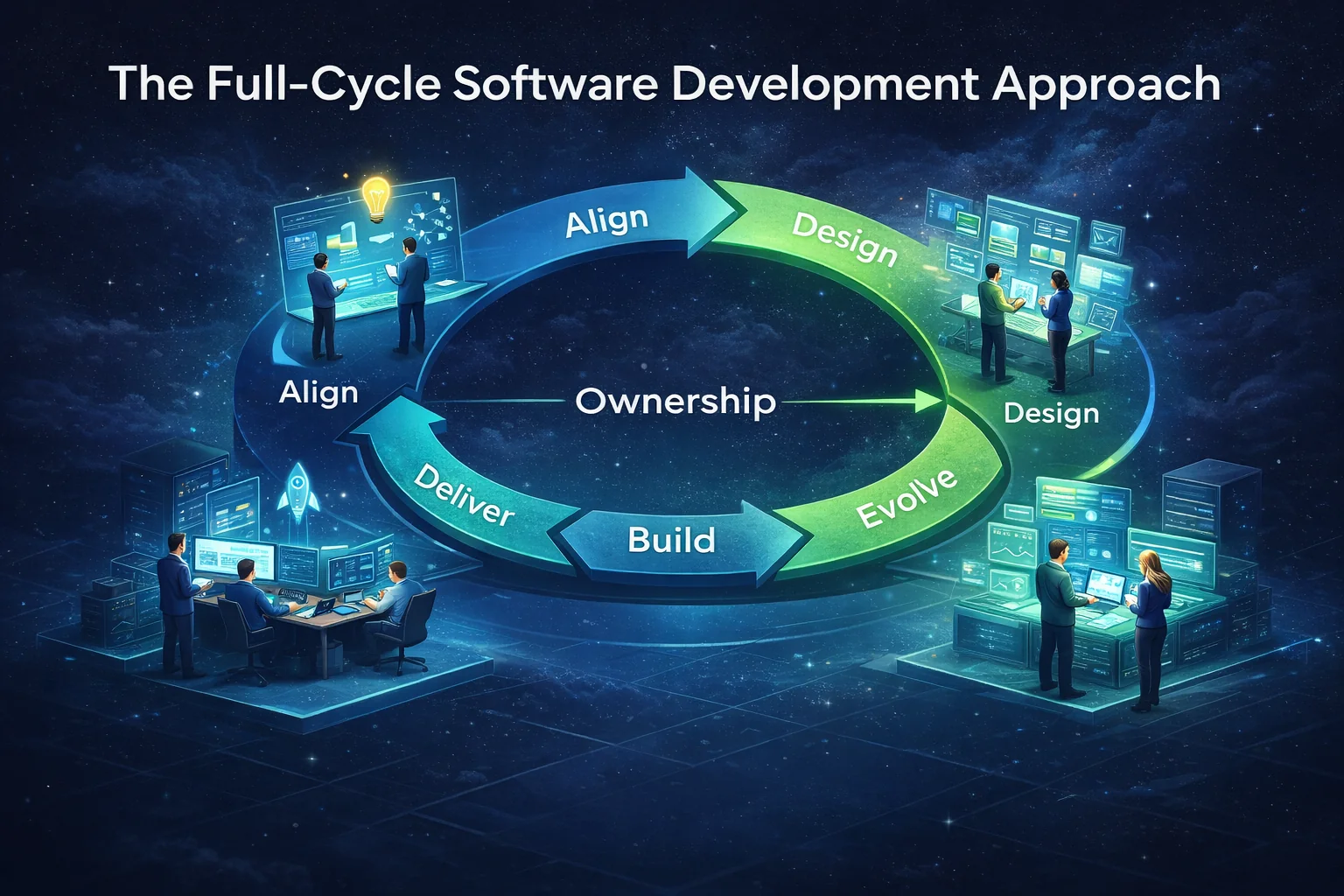
That means the work is treated as a connected lifecycle: understanding the business need, shaping the solution, designing the experience, building the product, testing it properly, launching it responsibly, and supporting it as it grows.
The client still sets goals and business direction. But the partner is expected to take real ownership of delivery.
This changes the relationship from "here are extra hands" to "here is a team responsible for outcomes."
For many organizations, software is important but not their core operational muscle. They may know exactly what business result they need, but not want to manage every sprint decision, architecture debate, QA dependency, and post-launch issue themselves.
That is where full-cycle becomes valuable.
Its strength is not just convenience. Its strength is reduced execution risk.
A strong full-cycle partner creates a tighter chain between business intent and shipped product. Fewer handoffs. Fewer interpretation errors. Fewer gaps between what was promised and what actually works in production.
This matters especially in projects where the software needs to do more than "exist." It needs to serve real users, integrate with operations, and remain useful after launch.
Full-cycle development is not just a label for a vendor that offers multiple services on a website. It only works when the lifecycle is truly connected.
A healthy full-cycle process usually includes four linked phases.
This is where the business problem is clarified before the team rushes into building.
The goal is not to create endless documents. The goal is to make sure the team understands what success actually looks like. What problem matters most? Who are the users? What constraints matter? What must happen first, and what can wait?
Good alignment reduces wasted development later.
This phase translates business goals into something usable and buildable.
That includes flow design, interface planning, validation of assumptions, and making sure the proposed solution is not only technically possible but sensible for real users.
Strong design work prevents teams from building the wrong thing efficiently.
This is where many vendors focus all their energy, but in a full-cycle approach it is one part of a wider system.
Development should happen with testing, release discipline, and technical quality built in from the start. The point is not just to produce features. It is to produce a product that can survive real usage and future change.
Shipping is not the end of the story.
Once real users interact with the product, new realities appear. Some assumptions are confirmed. Others are proven wrong. Performance issues emerge. Priorities change. New needs appear.
A full-cycle partner is supposed to stay accountable after launch, so the product can evolve without losing coherence.
A project can look inexpensive early and still become expensive later.
This often happens when ownership is split across too many disconnected players.
One team defines the scope. Another designs. Another develops. Someone else handles infrastructure. Later, a different team inherits support. Every transition costs time. Every handoff loses context. Every new team must rediscover why earlier decisions were made.
The result is not always dramatic failure. More often, it is slow drag.
Features take longer than expected. Small changes require more explanation than they should. Bugs recur in familiar areas. Priorities are misunderstood. Leaders spend more time translating between parties than making strategic decisions.
That operational drag becomes one of the most expensive parts of software delivery.
Full-cycle does not remove complexity, but it reduces the friction created by fragmented accountability.
The value of full-cycle development is usually seen in five areas.
Better continuity
The same delivery context carries from early planning to later releases. That reduces re-explanation, protects product intent, and makes future work faster.
Clearer accountability
There is less room for blame-shifting between design, build, and support functions. One partner owns the delivery chain.
Lower management overhead
Internal stakeholders spend less energy coordinating multiple outside contributors and more energy making business decisions.
Stronger quality discipline
When the team knows it will live with the consequences of what it ships, it tends to make better decisions around maintainability, testing, and release readiness.
More stable product evolution
Software almost never stands still. A full-cycle model supports change more effectively because the people evolving the product understand the system's history and tradeoffs.
Full-cycle is not automatically the best option for every company.
A dedicated team model can work extremely well when:
In that environment, buying focused execution capacity may be exactly the right move.
The mistake is not choosing a dedicated team. The mistake is choosing it when what you actually need is ownership.
A few questions can make the answer clearer.
Do you want to manage the work, or own the result?
If your team wants detailed control over delivery, a dedicated team can be a good fit. If your team wants a trusted partner to take responsibility for execution quality and continuity, full-cycle is likely the better model.
Is software core to your organization's operating strength?
If product delivery is already a strong internal capability, added capacity may be enough. If software is critical to the business but not something your leaders want to manage in depth every day, full-cycle often reduces risk.
Will this product need to evolve significantly?
If the project is narrow, fixed, and unlikely to change much, a staffing-style approach may be sufficient. If the product will grow, iterate, integrate, and remain strategically important, continuity becomes much more valuable.
Can your current team absorb coordination overhead?
If you already have bandwidth to manage backlog clarity, engineering direction, vendor coordination, QA alignment, and release pressure, you can carry more of the delivery burden. If not, full-cycle ownership can remove a large amount of avoidable strain.
Not every firm calling itself "full-cycle" truly works that way.
Some simply bundle services without integrating them. Others still depend on heavy client coordination while marketing themselves as outcome-driven.
So the real evaluation question is not whether a vendor uses the term. It is whether they demonstrate connected ownership.
Look for signs such as:
A partner that truly operates full-cycle should feel less like a staffing supplier and more like a delivery owner.
More leaders are realizing that software partnerships are not just procurement choices. They are operating-model choices.
The question is no longer only, "Where do we find developers?"
It is increasingly, "How do we reduce execution risk while still moving fast?"
That is why full-cycle development continues to matter. It gives organizations a way to compress the gap between business ambition and reliable delivery. It can improve clarity, reduce operational noise, and create a stronger foundation for growth.
Not because it magically solves every software problem.
But because it aligns responsibility with results.
If your company already has strong internal delivery leadership, a dedicated team may be the right extension model.
But if your challenge is not just capacity, and is really about coherence, accountability, speed of execution, and sustainable growth, full-cycle development deserves serious consideration.
The biggest advantage is not that someone else writes the code.
It is that someone is finally responsible for the whole journey.
Explore AblyCode's full-cycle software development services for discovery, architecture, design, engineering, and ongoing support. If you already lead delivery and need additional capacity, our dedicated software development teams offer another collaboration model.