
Most SaaS products do not fail because the first version was too small.
They fail because the first version was not designed to grow.
In the early stage, speed matters. Teams want to validate the idea, launch quickly, get feedback, and prove that users are willing to use or pay for the product.
That is why the MVP matters.
But as the product grows, a new problem appears. The same shortcuts that helped the team launch quickly can start slowing the product down.
Features become harder to add.
Customers ask for more integrations.
User roles become more complex.
Billing rules change.
Data volume increases.
Support requests become repetitive.
Security expectations rise.
The product is no longer only an MVP. It is becoming a real business platform.
That is where SaaS development needs to shift from fast delivery to thoughtful product engineering.
An MVP is built to test a business idea.
It should answer practical questions:
A good MVP should be focused. It should not try to include every feature from day one.
But the MVP becomes risky when teams mistake it for the long-term product foundation.
An MVP may work with a small number of users, limited data, simple permissions, and manual support. But once customers grow, that same product may struggle.
This is why SaaS development must be planned in stages.
The first goal is validation.
The second goal is scalability.
The third goal is operational maturity.
SaaS development has unique demands.
A normal internal application may support one company, one workflow, and one user group.
A SaaS product usually supports many customers, many users, many permission levels, and many usage patterns.
That changes the way the product must be designed.
A SaaS platform needs to think about:
The product is not only used by customers. It must also be operated by the SaaS company.
That is why SaaS development requires both product thinking and engineering discipline.
Many SaaS teams focus heavily on features.
That is understandable because customers ask for visible improvements.
But if the platform foundation is weak, every new feature becomes harder to deliver.
A SaaS team may keep adding modules, forms, dashboards, and reports, but the product becomes more fragile over time.
The better approach is to balance feature delivery with platform strength.
That means building the systems that make future work easier:
Good SaaS development does not only ask, Can we build this feature?
It also asks, Will this feature still work when the product has more users, more customers, and more data?
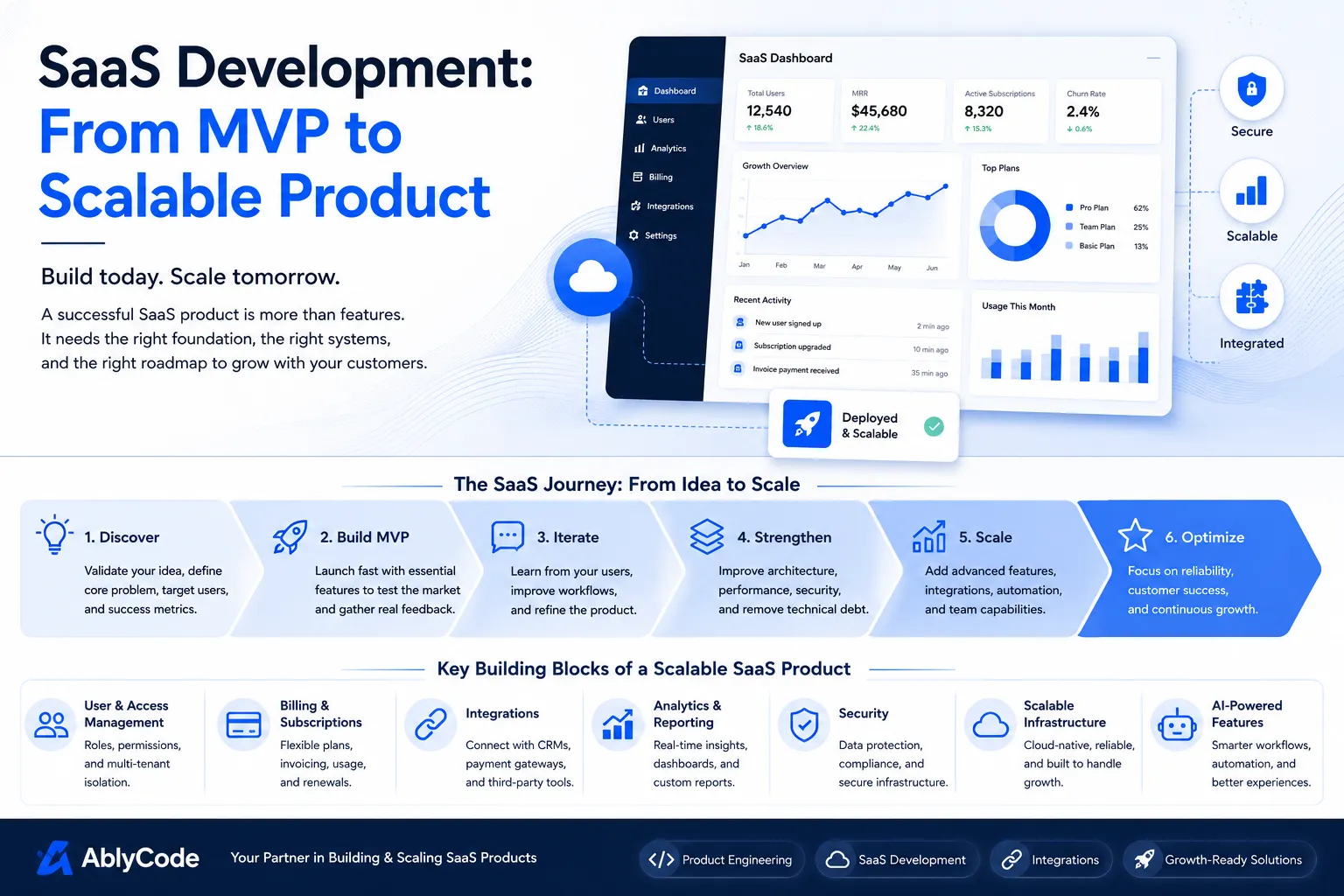
A SaaS product usually evolves through several stages.
This is where the product idea is shaped.
The team defines the target user, core problem, must-have features, and success metrics.
The goal is not to create a huge product specification. The goal is to understand what must be true for the product to be worth building.
Questions to answer:
Good discovery prevents the team from building too much too early.
This stage focuses on launching the first usable product.
The MVP should include only the core workflow needed to test the business idea.
For a SaaS product, the MVP may include:
The goal is to launch quickly but responsibly.
Speed matters, but the foundation should not be careless.
Once users start using the product, the team learns what matters.
Some features become more important than expected.
Some assumptions fail.
Some workflows need simplification.
Some customers ask for integrations.
Some users need more guidance.
At this stage, the product should evolve based on evidence, not assumptions.
The team should track:
The best SaaS products improve through real usage.
After the MVP starts gaining traction, the team must strengthen the foundation.
This may include:
This stage is often ignored because it is less visible than new features.
But it is essential for scale.
Once the product is stable, the team can focus on expansion.
This may include:
The product becomes more complete, but it should still remain easy to use.
At maturity, the SaaS product needs long-term discipline.
The focus shifts to reliability, customer success, security, performance, and continuous improvement.
The product should support:
This is where SaaS becomes a real business engine.
SaaS products often slow down for predictable reasons.
If onboarding, billing, reporting, support, or account setup requires too much manual work, the SaaS company becomes harder to scale.
Manual work may be manageable with 10 customers.
It becomes painful with 100 customers.
It becomes dangerous with 1,000 customers.
Early SaaS products often start with simple roles.
For example:
Admin
User
But growing customers may need more.
They may need managers, reviewers, finance users, external users, region-based access, department-based access, or custom permissions.
If permission design is weak, enterprise adoption becomes difficult.
Customers rarely use one tool.
They may need the SaaS product to connect with CRMs, ERPs, payment systems, analytics tools, support systems, identity providers, or internal databases.
If integrations are not planned well, every new connection becomes a custom project.
SaaS users expect visibility.
They want dashboards, exports, activity history, and performance metrics.
If reporting is slow or hard to customize, users may return to spreadsheets.
Technical debt is not always bad.
Some debt is acceptable in an MVP.
The problem starts when teams keep building on top of shortcuts without making time to improve the foundation.
Eventually, delivery speed drops.
A scalable SaaS product is not only about handling more traffic.
It is about handling more customers, more workflows, more data, more support needs, and more product complexity without breaking the business.
A scalable SaaS product usually has:
Scalability means the product can grow without every new customer creating heavy manual work.
Integrations are often one of the biggest growth requirements in SaaS.
Early customers may accept manual imports and exports. Larger customers usually expect the product to connect with their existing systems.
A SaaS product may need integrations with:
Good integration design improves product value.
It also reduces manual work for customers.
Instead of forcing users to copy data between tools, the SaaS product becomes part of their operating workflow.
That makes the product harder to replace and easier to adopt.
Billing is one of the most underestimated parts of SaaS development.
At first, billing may seem simple.
One plan. One price. One payment method.
But as the product grows, billing becomes more complex.
The business may need:
If billing logic is not planned properly, the team may end up managing revenue operations manually.
That creates errors and customer frustration.
Good SaaS development treats billing as part of the product, not an afterthought.
Security is not only an enterprise concern.
Even small SaaS products handle user accounts, business information, payment data, documents, analytics, or customer records.
Security should be built into the product foundation.
Important areas include:
As the product grows, security expectations rise.
Customers may ask about compliance, data handling, infrastructure, access control, and incident response.
It is easier to build these foundations early than to add them after the product becomes complex.
AI is becoming a practical layer inside SaaS products.
It can help users work faster, understand data better, and automate repetitive tasks.
Examples include:
But AI should not be added only because it sounds modern.
It should solve a real user problem.
A good AI feature should reduce effort, improve decisions, or simplify a workflow.
For SaaS companies, the question should be:
Where do users spend too much time?
Where do they need help making decisions?
Where do they repeat the same task?
Where can AI create clear product value?
Use this checklist before moving from MVP to a larger SaaS product.
Score each question from 1 to 5.
1 = Not true today
5 = Strongly true today
10-22: MVP stage
Your SaaS product may still be focused on validation. Keep the product simple, but avoid building foundations that will block the next stage.
23-37: Scale preparation stage
Your SaaS product may need stronger architecture, better onboarding, integrations, permissions, reporting, and operational workflows.
38-50: Scale-ready investment stage
Your SaaS product likely needs a more mature platform approach, including stronger engineering systems, automation, security, analytics, and growth-ready architecture.
More features do not always mean more value.
Early SaaS products should focus on the core user problem.
Too many features can slow the product, confuse users, and increase maintenance cost.
If users do not understand how to start, they may leave before seeing value.
Good onboarding is one of the most important parts of SaaS growth.
Billing, subscriptions, invoices, trials, renewals, and plan limits need careful planning.
Weak billing design can create operational and customer support problems.
If the team does not track usage, it cannot understand what users actually do.
Product analytics helps teams make better decisions.
Security should not wait until the product becomes large.
Authentication, data protection, access control, and monitoring should be part of the foundation.
A SaaS product should evolve with user evidence.
Without feedback loops, the team may build features that sound useful but do not improve adoption or retention.
At AblyCode, we help businesses design, build, and scale SaaS products with startup agility and enterprise reliability.
Our SaaS development approach focuses on the full product journey:
We do not see SaaS development as only coding features.
We see it as building a product system that can grow with customers, users, data, and business goals.
A SaaS MVP is the beginning, not the destination.
The first version helps validate demand.
The next version must support growth.
That means stronger architecture, better onboarding, reliable integrations, secure access, useful analytics, and workflows that reduce manual operations.
Growing SaaS products need more than speed. They need a foundation that allows speed to continue.
For founders and business leaders, the real question is not only:
Can we launch the MVP?
The better question is:
Can this product scale after customers start depending on it?
That is where thoughtful SaaS development makes the difference.
AblyCode helps businesses design, build, and scale SaaS platforms, customer portals, dashboards, integrations, AI-powered features, and growth-ready software products.