
Many businesses start their AI journey with the same question:
Should we use RAG or fine-tuning?
It sounds like a technical decision, but it is actually a product decision.
The right answer depends on what the AI application needs to do, what kind of data it uses, how often that data changes, how accurate the answer must be, and how much control the business needs over output quality.
Some companies want an AI assistant that can answer questions from internal documents.
Some want a support bot that knows product policies.
Some want an AI data analyst that can explain business metrics.
Some want a system that produces consistent reports in a specific format.
Some want AI features inside a SaaS product.
These are different problems.
And they do not always need the same AI architecture.
RAG and fine-tuning are both useful, but they solve different parts of the problem.
The mistake is treating them as competitors in every situation.
A better question is:
What does the business need the AI system to know, retrieve, reason about, and produce?
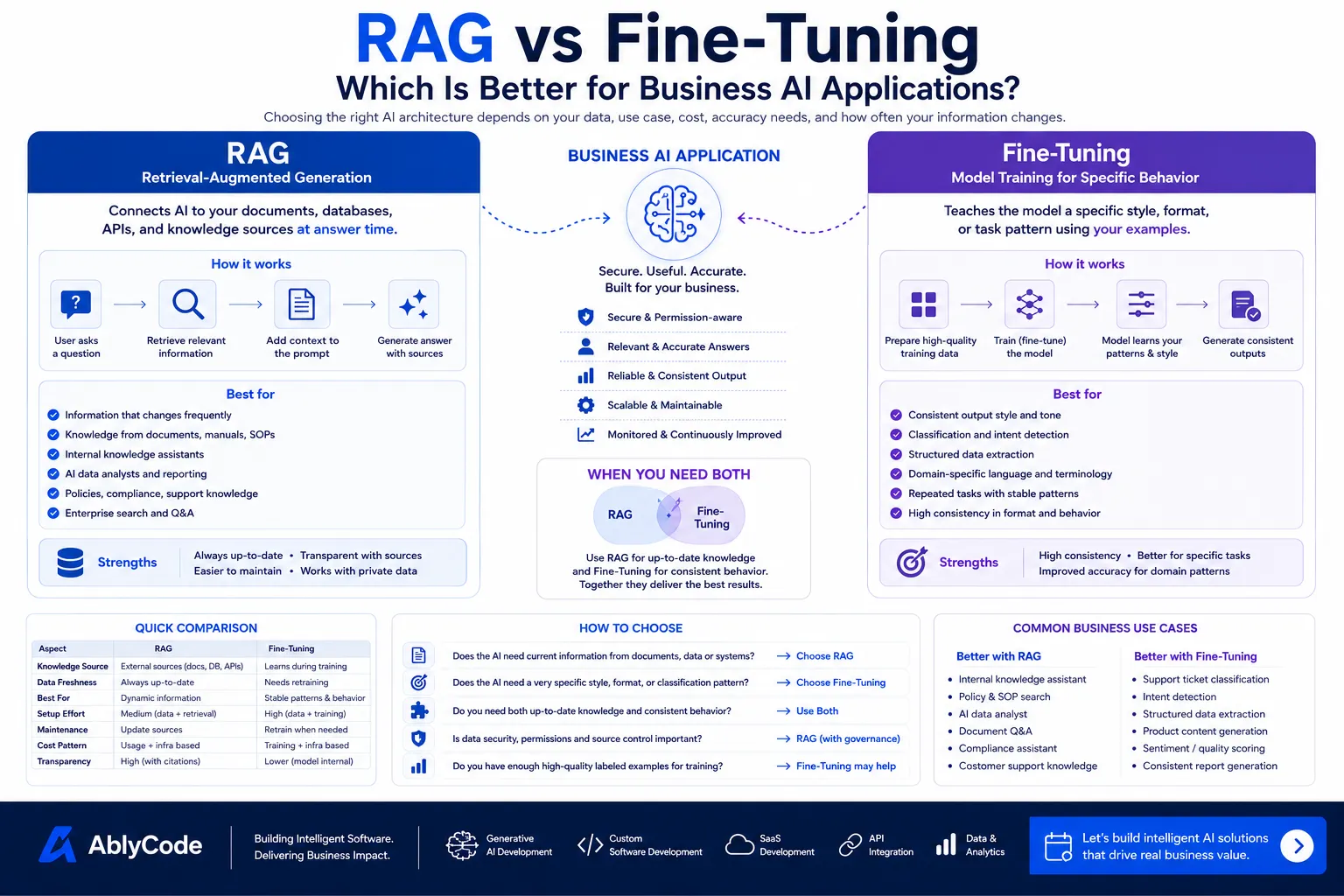
RAG stands for Retrieval-Augmented Generation.
In simple terms, RAG lets an AI model search trusted business information before generating an answer.
Instead of relying only on what the model already knows, the system retrieves relevant information from approved sources such as documents, databases, knowledge bases, PDFs, help articles, tickets, policies, reports, product manuals, or internal systems.
Then the AI uses that retrieved context to answer the user's question.
A RAG system usually works like this:
This is useful because business information changes constantly.
Policies change.
Prices change.
Documents change.
Product features change.
Customer data changes.
Dashboards change.
Internal processes change.
RAG helps AI applications stay connected to current business knowledge without retraining the model every time information changes.
Fine-tuning means training a model further on specific examples so it learns a particular behavior, style, structure, or task pattern.
Instead of giving the model external information at answer time, fine-tuning adjusts how the model responds.
For example, a company might fine-tune a model to:
Fine-tuning is useful when the problem is not mainly about retrieving changing information.
It is useful when the business needs the AI to behave in a specific way.
That distinction matters.
RAG is usually about giving the AI better context.
Fine-tuning is usually about shaping the AI's behavior.
The easiest way to think about it is this:
RAG helps the AI access the right information.
Fine-tuning helps the AI respond in the right way.
If your AI system needs current knowledge from documents, data, or systems, RAG is often the better starting point.
If your AI system needs a highly consistent format, classification pattern, tone, or task behavior, fine-tuning may be useful.
If your system needs both reliable knowledge and consistent behavior, you may eventually use both.
RAG is usually the better choice when your information changes often.
Business knowledge rarely stays still.
Internal policies get updated. Product documentation changes. Pricing changes. Compliance rules change. Project documents evolve. Customer records move. Business metrics refresh every day.
If the AI application needs to answer from this kind of information, fine-tuning alone is usually not the right approach.
You do not want to retrain a model every time a document changes.
RAG is better because the AI can retrieve fresh context when the user asks a question.
RAG is especially useful for:
For these use cases, the value comes from connecting AI to approved business knowledge.
Imagine an employee asks:
What is the approval process for enterprise discounts?
The answer may depend on internal policies, sales rules, finance approval thresholds, and the latest pricing guidelines.
If those documents change regularly, RAG is the right pattern.
The system retrieves the latest approved documents and answers from them.
The answer can also show where the information came from.
That makes the AI more useful and more trustworthy.
An AI data analyst may answer questions like:
Show revenue by region for the last quarter.
Which product category had the highest growth?
Compare this month with the same month last year.
Show this as a chart.
Export the result to Excel.
This type of system should not rely on a model's memory.
It needs to retrieve or query real business data.
That makes RAG, data access, semantic layers, governed metrics, and integrations more important than fine-tuning.
The AI must answer from current, permission-aware data.
Fine-tuning is useful when the AI needs to perform a repeated task in a consistent way.
The business may not need the AI to search new documents every time.
Instead, it may need the AI to follow a specific pattern.
Fine-tuning can help with:
For example, if a business receives thousands of support tickets and needs each ticket classified into a strict set of categories, fine-tuning may improve consistency.
If a company wants product descriptions written in a very specific tone and structure, fine-tuning may help.
If a system needs to convert messy input into a repeatable structured output, fine-tuning can be useful.
A customer writes:
The payment went through but my subscription is still not active.
The system needs to classify this as:
If the company has many historical examples of correctly labeled tickets, fine-tuning can help the model learn that pattern.
RAG may still be useful if the system needs to retrieve policy details or resolution steps, but the classification behavior itself may benefit from fine-tuning.
Some businesses need reports in a fixed format.
For example:
If the company has many examples of good reports, fine-tuning may help the AI produce more consistent output.
Again, if the report depends on changing data, RAG or live data access may still be needed.
Fine-tuning shapes the output.
RAG supplies the facts.
In many real business applications, the best architecture is not RAG or fine-tuning.
It is both.
For example, an enterprise AI assistant may need to:
In that case, RAG handles knowledge retrieval, while fine-tuning or instruction tuning can help with output behavior.
Another example is an AI-powered SaaS product.
RAG may connect the AI to user-specific product data.
Fine-tuning may help the AI generate responses in the product's tone and format.
The combination can be powerful, but it must be designed carefully.
Adding both without a clear reason can increase cost and complexity.
One common mistake is using fine-tuning when the real need is updated business knowledge.
For example, a company may want the AI to answer questions from policy documents, product manuals, contracts, or internal reports.
If that information changes regularly, fine-tuning is not ideal.
A fine-tuned model does not automatically know when a document changes.
You would need to retrain or update the model again.
RAG is usually better because the system retrieves the latest information at answer time.
Another mistake is using RAG when the problem is actually poor task design.
If the AI has the right information but still responds in an inconsistent format, retrieves too much, ignores structure, or fails to classify correctly, the issue may not be retrieval.
It may be prompt design, workflow design, evaluation, or fine-tuning.
RAG gives the model context.
It does not automatically make the model behave exactly how your business wants.
RAG is only as good as the information it retrieves.
If your documents are outdated, duplicated, poorly structured, or contradictory, the AI system may produce weak answers.
Before building a RAG application, businesses should check:
A messy knowledge base creates messy AI.
RAG does not remove the need for information governance.
AI systems should be tested like products.
Many teams build a prototype, test a few questions, and assume it works.
That is not enough.
For a business AI application, the team should create test cases.
For RAG, test whether the system retrieves the right sources and answers accurately.
For fine-tuning, test whether the model produces the right format, classification, tone, or task output.
For both, test failure cases.
What happens when the answer is not available?
What happens when the user asks something outside their permission level?
What happens when documents conflict?
What happens when data is incomplete?
Evaluation is what turns an AI demo into a reliable business system.
Cost depends on the use case, model, infrastructure, data volume, and usage pattern.
But there are general differences.
RAG usually requires investment in data preparation, embeddings, vector search, retrieval logic, permissions, source management, and backend integration.
Fine-tuning usually requires good training examples, dataset preparation, model training, evaluation, hosting or API costs, and retraining when behavior needs to change.
RAG may be more flexible for changing knowledge.
Fine-tuning may be more efficient for repeated tasks when the behavior is stable.
For many businesses, RAG is the better first step because it connects AI to current knowledge without committing to model training.
Fine-tuning becomes more useful when the team has enough examples and a clear need for consistent behavior.
Security must be designed into both approaches.
For RAG, the main concern is data access.
The AI should only retrieve information the user is allowed to see.
That means the system needs role-based access, document permissions, source filtering, audit logs, and careful handling of sensitive data.
For fine-tuning, the main concern is training data.
The business must be careful about what data goes into the fine-tuning dataset.
Sensitive customer information, private business data, credentials, confidential documents, or regulated data should not be included casually.
Both approaches need governance.
The question is not only, "Which works better?"
The question is also, "Which can we operate safely?"
RAG and fine-tuning have different maintenance patterns.
RAG systems require ongoing source management.
Documents must stay updated. Connectors must work. Retrieval quality must be monitored. Permissions must remain correct. Search results must be evaluated.
Fine-tuned models require ongoing behavior monitoring.
Outputs must be tested. New examples may be needed. The model may need retraining when requirements change. Evaluation datasets must stay relevant.
Neither approach is maintenance-free.
A reliable AI product needs ownership after launch.
A business can start with a few practical questions.
Does the AI need current business information?
If yes, start with RAG.
Does the information change often?
If yes, RAG is usually better.
Does the AI need to follow a very specific response style or classification pattern?
If yes, fine-tuning may help.
Do you have enough high-quality examples for training?
If no, fine-tuning may not be ready yet.
Does the AI need to answer from private documents or internal systems?
If yes, RAG with strong access control is usually important.
Does the AI need both fresh knowledge and consistent behavior?
Then consider a hybrid approach.
The goal is not to choose the most advanced architecture.
The goal is to choose the architecture that fits the business problem.
Use this simple guide.
Choose RAG when:
Choose fine-tuning when:
Choose both when:
Internal knowledge assistant: usually RAG.
Policy assistant: usually RAG.
AI data analyst: usually RAG plus data access.
Support ticket classification: often fine-tuning.
Support answer assistant: often RAG plus workflow design.
Document summarization: often RAG, sometimes fine-tuning.
Contract review assistant: usually RAG plus rules and human review.
AI-powered SaaS feature: depends on the feature, often hybrid.
Report generator: often RAG plus structured output design.
Customer portal assistant: usually RAG plus access control.
Legacy software modernization assistant: often RAG plus code analysis workflows.
Whether a business chooses RAG, fine-tuning, or both, the AI system needs a strong product foundation.
Important components include:
The model is only one part of the system.
The surrounding architecture determines whether the AI application becomes useful, safe, and maintainable.
At AblyCode, we help businesses design and build generative AI applications that fit real workflows.
That includes AI data analysts, knowledge assistants, document intelligence tools, workflow automation systems, AI-powered SaaS features, customer portal assistants, and business reporting tools.
We do not start by asking whether the project needs RAG or fine-tuning.
We start by understanding the business problem.
What does the user need to do?
What data is required?
How often does that data change?
What output is expected?
What permissions are needed?
Where should a human review the result?
How will success be measured?
From there, we design the right AI architecture.
Sometimes that means RAG.
Sometimes it means fine-tuning.
Sometimes it means both.
The goal is not to build an impressive AI demo.
The goal is to build an AI system that is useful, secure, accurate, and maintainable.
RAG and fine-tuning are not rivals.
They are tools for different AI problems.
RAG helps business AI systems use current, trusted information.
Fine-tuning helps AI systems produce more consistent behavior.
Many real-world AI applications need a careful combination of retrieval, instruction design, structured workflows, evaluation, and governance.
For business leaders, the most important decision is not choosing a buzzword.
It is understanding the workflow clearly enough to design the right system around it.
AI becomes valuable when the architecture matches the problem.
That is where RAG, fine-tuning, and thoughtful software development come together.
AblyCode helps companies design and build AI data analysts, knowledge assistants, document intelligence tools, workflow automation systems, and AI-powered SaaS features.