

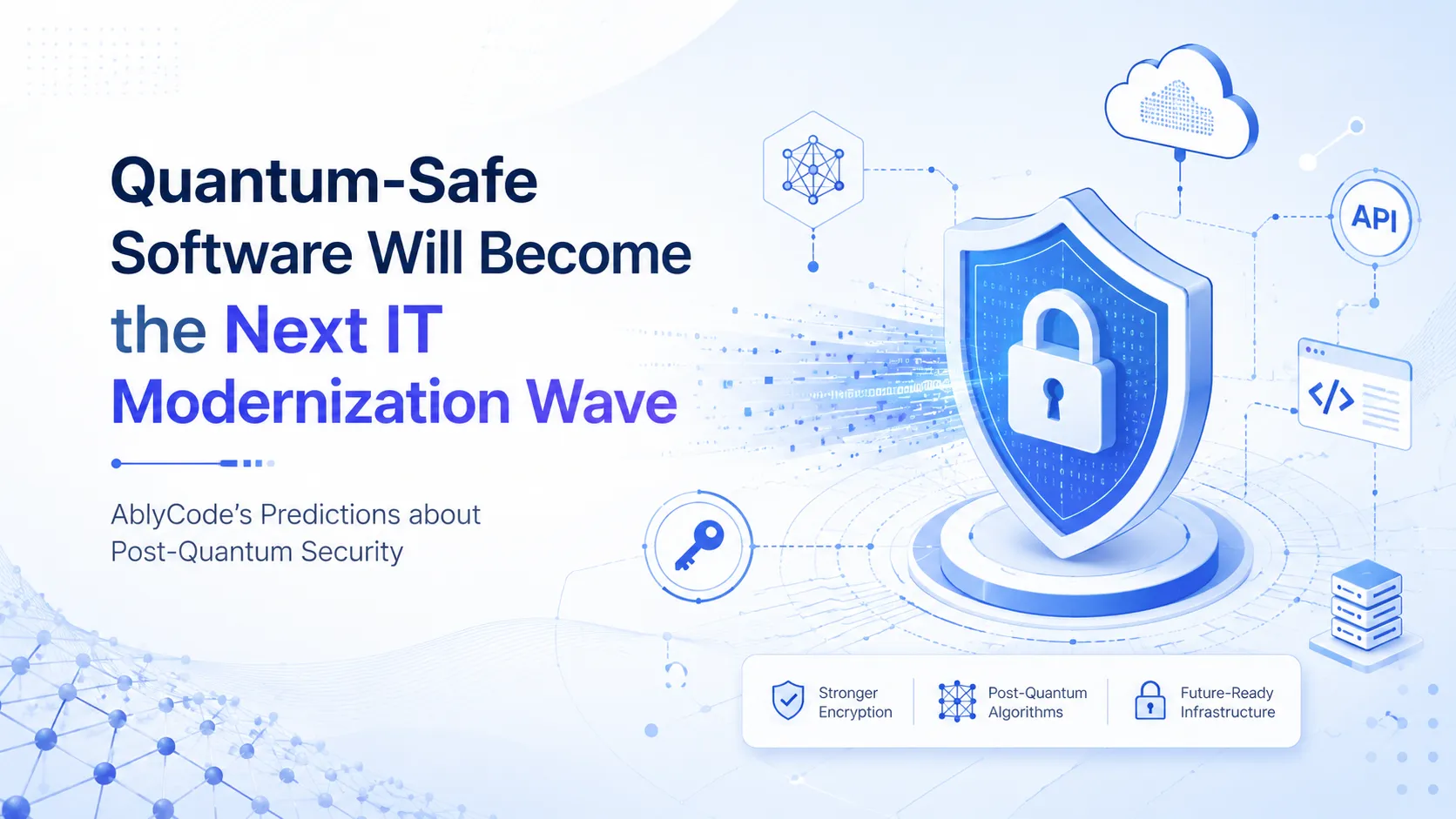
The biggest shift in cybersecurity may not arrive as a dramatic breach.
It may arrive as a slow realization that much of today's software was built on cryptographic assumptions that will not last forever.
For years, enterprise security has focused on familiar concerns: passwords, access control, cloud misconfiguration, phishing, ransomware, API exposure, and data leakage. Those problems still matter. But another layer is moving closer to the center of IT strategy.
Post-quantum security.
The concern is simple: powerful enough quantum computers could eventually break widely used public-key cryptography. That includes cryptographic systems that protect web traffic, APIs, identity flows, software updates, certificates, digital signatures, banking systems, and confidential enterprise data.
This does not mean every company needs to panic today.
It does mean that software leaders should stop treating quantum-safe security as a distant research topic.
In August 2024, NIST finalized its first three post-quantum cryptography standards: FIPS 203 for ML-KEM, FIPS 204 for ML-DSA, and FIPS 205 for SLH-DSA. These standards are designed to help organizations protect systems against future quantum attacks. Wikipedia
That moment changed the conversation.
Post-quantum security is no longer only about theory. It is becoming a software modernization problem.
Most companies are familiar with security upgrades.
They have upgraded TLS versions. They have replaced weak ciphers. They have rotated certificates. They have moved from outdated password policies to stronger identity systems. They have added MFA and stronger API authentication.
But post-quantum migration is different.
It does not affect only one login screen or one cloud setting.
Cryptography is buried everywhere.
It sits inside browser connections, mobile apps, APIs, VPNs, device communication, payment systems, identity providers, internal services, signed documents, code-signing pipelines, firmware updates, database connections, backup systems, and long-term archives.
That is why quantum-safe modernization will not be a single tool purchase.
It will be an inventory problem, an architecture problem, a vendor problem, and a software lifecycle problem.
The companies that handle it well will not be the ones that wait for a deadline. They will be the ones that start understanding their cryptographic dependencies early.
One reason post-quantum security feels confusing is that the risk is not only about what can be decrypted today.
It is also about what can be collected today and decrypted later.
This is often called the "harvest now, decrypt later" risk. The idea is that attackers may capture encrypted data now, store it, and wait until future computing capabilities make it easier to decrypt. This matters especially for data that remains sensitive for many years, such as financial records, health data, legal documents, intellectual property, government records, product designs, and strategic communications. Reuters recently described how crypto firms are already preparing for quantum threats to encryption as the risk draws nearer. Reuters
For short-lived data, the urgency may be lower.
For long-lived sensitive data, the timeline is different.
If information must remain confidential for 10 or 20 years, then the risk window has already started.
That is why quantum-safe planning belongs in today's architecture discussions, not only in tomorrow's security roadmap.
The most important concept in the next phase of security may be crypto-agility.
Crypto-agility means software can change cryptographic algorithms, key sizes, certificate models, and protocols without rewriting the entire system.
That sounds simple.
In practice, many systems are not built that way.
Cryptographic choices are often hardcoded, hidden inside libraries, buried in vendor products, or assumed by old integrations. A legacy service may depend on outdated certificate behavior. A mobile app may require a specific handshake model. An API gateway may not support newer algorithms. A hardware device may not be upgradeable without operational disruption.
This creates a major modernization challenge.
The future will reward systems that can adapt.
Software leaders should begin asking:
Quantum-safe security is not only about choosing the right algorithm. It is about designing systems that can change when the standard changes.
Many organizations will make the mistake of jumping directly to implementation.
They will ask, Which post-quantum algorithm should we use?
That is not the first question.
The first question is:
Where is cryptography actually used in our software and infrastructure?
Most companies do not have a clean answer.
They may know their cloud provider, identity provider, and major security tools. But they may not know every internal service, old application, certificate dependency, embedded device, data transfer flow, signed artifact, or third-party API that depends on current cryptographic assumptions.
This is why post-quantum readiness should begin with discovery.
A practical readiness effort should identify:
Once the map exists, the company can prioritize.
Without the map, the migration becomes guesswork.
Not every company will move at the same speed.
Some sectors will face earlier pressure.
Financial services, healthcare, government contractors, defense, critical infrastructure, telecom, cloud platforms, payment systems, and enterprise SaaS providers will likely feel the strongest push.
Why?
Because these industries handle long-lived sensitive data, regulated workflows, high-trust transactions, or infrastructure that many other systems depend on.
A small e-commerce website may not need to lead the migration.
A fintech platform, healthcare data system, identity provider, or enterprise SaaS product may need to plan earlier.
The more trust your software carries, the more important quantum-safe readiness becomes.
This is also why post-quantum security will become part of enterprise sales conversations.
Customers may begin asking vendors:
Security readiness will become part of buyer confidence.
Many companies think about cryptography only in terms of websites.
But modern businesses run on APIs.
APIs connect customer portals, mobile apps, payment gateways, CRMs, ERPs, data warehouses, analytics platforms, logistics systems, identity providers, and internal workflows.
That means post-quantum readiness will affect integration architecture.
A company may update one system but still depend on older encryption through a vendor API. A SaaS product may modernize its backend while customer integrations remain tied to legacy certificates. A mobile app may support newer protocols, but a partner gateway may not.
This is where the transition becomes complex.
Quantum-safe modernization is not only an internal engineering project. It is an ecosystem project.
Every important integration will need to be understood, tested, and eventually upgraded.
That is why API governance, documentation, observability, and versioning will become even more important.
The hardest systems to modernize will not be the newest cloud applications.
They will be legacy applications.
Older systems often contain assumptions that no one wants to touch. They may depend on old libraries, outdated runtime environments, fragile integrations, unsupported operating systems, or vendor software that cannot be upgraded easily.
These systems may still run critical workflows.
That creates a risk.
If a legacy platform holds sensitive data, signs documents, handles authentication, or connects to regulated workflows, it cannot be ignored.
Post-quantum planning may become one more reason to modernize old systems.
Not because every legacy system is immediately unsafe.
But because systems that cannot be inspected, updated, or adapted become harder to trust.
The future of security will favor systems that are observable, documented, upgradeable, and modular.
Most users do not understand encryption algorithms.
They should not have to.
But enterprise buyers, auditors, regulators, and security teams will want clearer answers.
They will want to know what is protected, how it is protected, what is upgradeable, and what remains at risk.
This means software vendors will need stronger security communication.
Not marketing claims.
Clear architecture.
Clear controls.
Clear audit trails.
Clear vendor dependencies.
Clear migration plans.
The companies that win trust will be the ones that can explain their security posture without hiding behind vague language.
Quantum-safe security will push more businesses toward transparent engineering discipline.
AI will help with security analysis, dependency discovery, code review, documentation, and risk prioritization.
But AI will not magically make systems quantum-safe.
The work still requires engineering judgment.
Teams must understand protocols, infrastructure, data flows, certificates, APIs, vendors, compliance needs, and operational risk.
AI may accelerate parts of the process, but the migration still needs architecture ownership.
This is a useful reminder for technology leaders.
The next wave of IT modernization will not be only AI-driven. It will also be security-driven.
Agentic AI may change how software works.
Quantum-safe security may change how software is trusted.
Both shifts matter.
The smartest move is not to replace every cryptographic component immediately.
The smartest move is to prepare the organization to migrate safely.
Start with a few practical questions:
These questions are more useful than chasing hype.
They help companies understand readiness before urgency arrives.
Post-quantum security will become one of the next major IT modernization waves.
It will start quietly.
First with regulated industries.
Then with enterprise SaaS.
Then with vendor security questionnaires.
Then with procurement requirements.
Then with architecture standards.
Eventually, quantum-safe readiness will become a normal expectation for software that handles sensitive business data.
The shift will not be instant. But it will be deep.
It will affect architecture, APIs, data storage, vendor selection, cloud security, compliance, and legacy modernization.
The companies that prepare early will have an advantage.
Not because they predict the exact date quantum computers become dangerous.
But because they will understand their systems better, modernize weak foundations earlier, and build software that can adapt.
Quantum-safe software is not just a cryptography upgrade.
It is a trust upgrade.
It forces companies to answer a deeper question:
Can our systems protect business data not only against today's threats, but also against tomorrow's capabilities?
That is why post-quantum security belongs in the same conversation as application modernization, API integration, cloud architecture, and enterprise software design.
The future will not reward systems that are only functional.
It will reward systems that are adaptable.
Observable.
Secure.
Upgradeable.
And trusted for the long term.
That is where quantum-safe software becomes more than a security trend.
It becomes infrastructure for the next generation of digital business.
AblyCode helps businesses modernize applications, secure APIs, integrate enterprise systems, and build scalable software platforms with long-term reliability in mind.