
Growing businesses rarely slow down because of ambition.
They slow down because the systems around them cannot keep up.
In our survey, we asked business and technology leaders where software creates the most value as companies grow. The pattern was clear: businesses do not choose custom software only because they want something unique. They choose it when existing tools no longer match how the business actually works.
A company may have strong demand, a good team, loyal customers, and a clear growth plan. But if everyday operations still depend on spreadsheets, disconnected tools, manual approvals, repeated data entry, and workarounds, growth becomes harder than it should be.
At that stage, the problem is not effort.
The problem is friction.
That is where custom software development becomes a speed advantage.
It helps growing businesses reduce operational drag, improve visibility, automate repetitive work, connect systems, and move from manual coordination to faster execution.
Many businesses start with simple tools.
A spreadsheet tracks orders. A shared drive stores documents. A small CRM manages leads. A payment tool handles invoices. A messaging app carries updates. A few people remember the process.
This works in the early stage because the team is small and communication is direct.
But as the business grows, the same setup becomes fragile.
More customers create more requests.
More team members create more handoffs.
More services create more exceptions.
More reporting needs create more spreadsheet work.
More systems create more duplicate data.
What once felt flexible starts to feel slow.
The business is growing, but the workflow is still built for an earlier version of the company.
That is where custom software can help.
In our survey, we asked growing businesses and technology leaders where their teams lose the most time as operations scale.
The responses showed a clear pattern: companies do not slow down only because they lack people. They slow down because their systems, workflows, and tools stop matching how the business actually operates.
Most respondents were not asking for more software in a generic sense. They wanted fewer manual steps, fewer disconnected tools, better visibility, and faster execution.
Three findings stood out.
Many teams still depend on spreadsheets, shared folders, email threads, and repeated status follow-ups to run important workflows.
These methods may work in the early stage, but they become harder to manage when customer volume, team size, and operational complexity increase.
A process that takes 10 minutes when there are five customers can become a serious bottleneck when there are 500.
That is why manual work is often one of the first signs that the business has outgrown its current systems.
Respondents often described situations where one tool handled sales, another handled finance, another handled operations, and another handled reporting.
The tools existed, but the business process still depended on people moving information between them.
That gap creates delays, duplicate data entry, reporting errors, and slow decisions.
The business may technically have software, but the workflow is still manual because the systems do not work together.
Growing businesses need faster answers.
Leaders want to know what is happening across sales, operations, customers, projects, inventory, or finance without waiting for someone to prepare a manual report.
They want to see where work is stuck, which processes are slowing down, what needs approval, where revenue is moving, and where customer experience is being affected.
This is where custom dashboards, workflow platforms, integrations, and internal software systems become valuable.
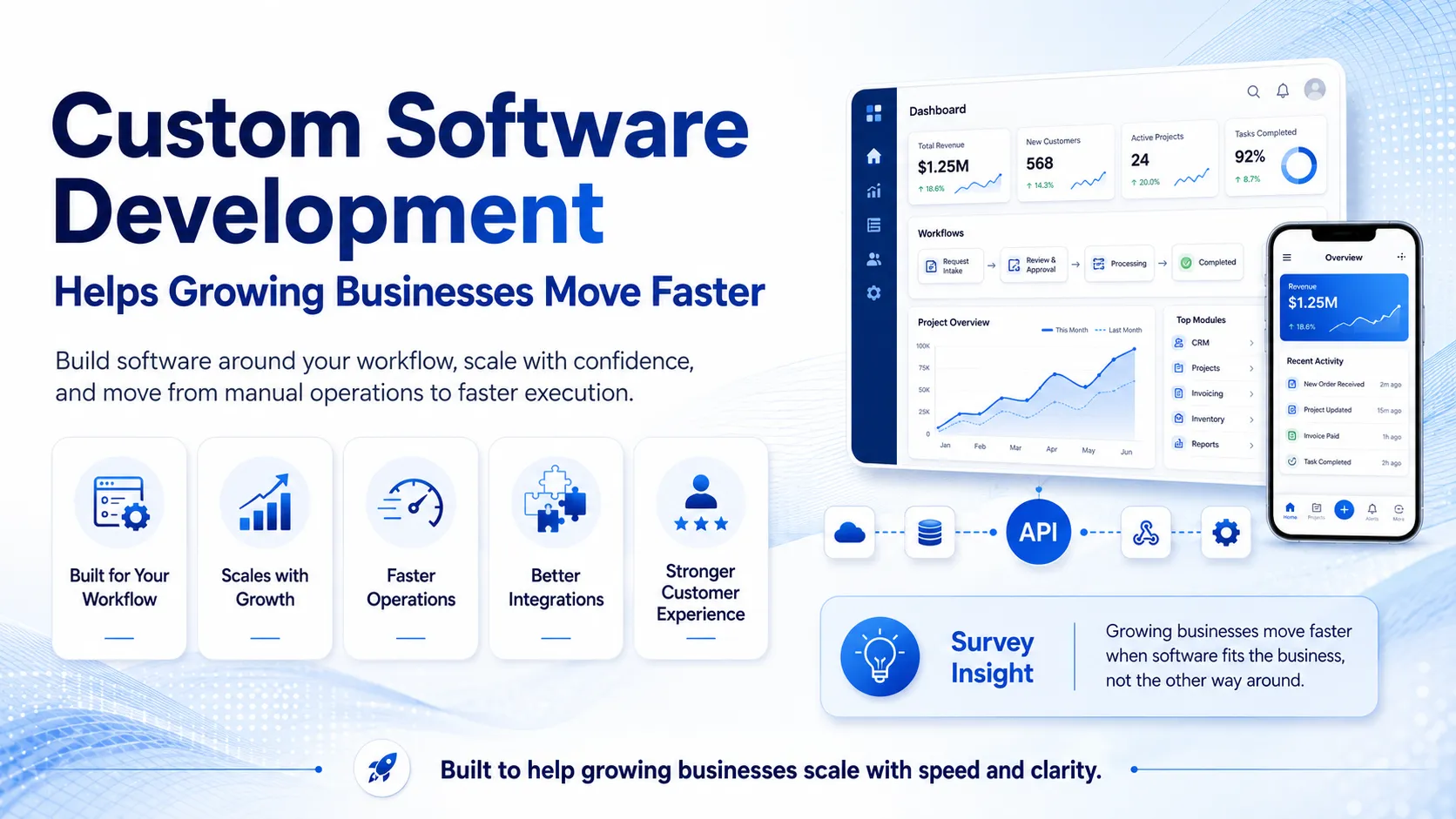
Our survey showed that growing businesses move faster when software fits the business, not the other way around.
Many teams already use multiple tools, but still depend on manual effort to connect the dots between them.
Custom software reduces that friction by connecting workflows, automating repeated steps, and giving teams one reliable place to manage the work that matters most.
Off-the-shelf software is useful.
It can be the right choice for many standard needs.
A company may use ready-made tools for accounting, email, messaging, payroll, ticketing, or sales management.
The problem starts when the business process becomes more specific than the tool.
For example, a sales team may need pricing rules that depend on region, customer type, and contract history.
An operations team may need approvals that change based on order value, stock availability, and delivery timeline.
A service team may need customer records connected with invoices, support tickets, and product usage.
A management team may need dashboards that combine data from several departments.
A finance team may need reports that do not exist in any one system.
Generic tools often solve one part of the process. But growing businesses need the full workflow to move smoothly.
When teams begin creating spreadsheets outside the system, sending repeated reminders, copying data between tools, or building manual reports every week, it is a sign that the software stack is no longer supporting the business properly.
A common misunderstanding is that custom software means replacing every existing tool.
That is not usually the right approach.
Good custom software development often means building the missing layer between people, processes, and systems.
Sometimes that means a new internal portal.
Sometimes it means a customer dashboard.
Sometimes it means a workflow automation system.
Sometimes it means integrating existing tools through APIs.
Sometimes it means modernizing an old application so it can support the next stage of growth.
The goal is not to build software for the sake of ownership.
The goal is to remove friction from the business.
Custom software creates speed in several practical ways.
Manual work is one of the most common hidden costs in growing businesses.
Teams spend time entering the same data twice, checking statuses manually, preparing reports, chasing approvals, and moving information from one system to another.
This work may not look expensive at first. But as volume grows, it becomes a serious drag.
Custom software can automate repeated steps and reduce the manual coordination required to complete daily operations.
For example, instead of a team manually checking whether an order is approved, paid, packed, and dispatched, a custom workflow system can track the full lifecycle and notify the right people at the right time.
The result is faster movement and fewer missed steps.
Many companies already have useful tools, but those tools do not always talk to each other.
Sales data may live in a CRM.
Payment data may live in an accounting tool.
Inventory data may live in another system.
Support requests may live somewhere else.
When systems are disconnected, people become the integration layer.
They copy data. They reconcile numbers. They ask for updates. They create reports manually.
Custom software can connect these systems through APIs and integrations, allowing information to move automatically.
This gives teams cleaner workflows and gives leaders more reliable visibility.
Growing businesses need faster decisions.
But fast decisions require clear information.
If leaders must wait for someone to prepare reports, combine spreadsheets, or confirm numbers across departments, decision-making slows down.
Custom dashboards and reporting systems help teams see the current state of the business without waiting for manual updates.
A good dashboard can show:
The point is not only to show data. The point is to make the right data visible at the right time.
Internal inefficiency eventually becomes a customer experience problem.
When teams use disconnected tools, customers may experience slower response times, inconsistent updates, repeated questions, and delayed service.
Custom software can improve the customer experience by giving customers, teams, and managers better access to the same information.
Examples include customer portals, self-service dashboards, order tracking systems, support request platforms, automated notifications, digital onboarding flows, document upload portals, and appointment or booking systems.
When customers can get answers faster, the business feels more professional and reliable.
Growth often pushes companies to hire more people to manage more work.
Sometimes that is necessary.
But sometimes businesses hire people to compensate for broken workflows.
Custom software can help companies scale without adding avoidable operational complexity.
Instead of adding more manual coordinators, the business can automate routing, approvals, reporting, reminders, and status tracking.
This does not remove the need for people. It helps people spend more time on valuable work and less time managing repetitive processes.
Manual operations often look manageable until they become part of daily culture.
A team may say:
We just update this sheet every morning.
We send a reminder message when approval is pending.
We manually export this report every Friday.
We copy this data into another tool.
We ask the finance team to confirm before moving forward.
Individually, each step may feel small.
Together, they create operational drag.
This drag affects speed, accuracy, accountability, and customer experience.
It also affects morale. Good employees become frustrated when they spend too much time doing repetitive coordination instead of meaningful work.
Custom software helps by turning repeated manual patterns into structured workflows.
Custom software is not always the first answer.
If a business problem can be solved well with a simple ready-made tool, that may be the better choice.
Custom development becomes worth considering when:
The question is not, Can we buy a tool?
The better question is, Will this tool support the way our business needs to grow?
If the answer is no, custom software may create better long-term value.
In many growing businesses, speed does not come only from new software. It comes from connecting what already exists.
API development and software integration are often central to custom software projects.
A business may need to connect:
When integrations work properly, teams stop wasting time transferring information manually.
The business gets cleaner data, faster workflows, and fewer operational blind spots.
Digital transformation can sound like a large corporate initiative, but for growing businesses it often starts with practical improvements.
A manual approval becomes a digital workflow.
A spreadsheet becomes a dashboard.
A repeated email process becomes an automated notification.
A disconnected customer journey becomes a self-service portal.
A legacy application becomes a modern cloud platform.
These changes may look small individually, but together they make the business faster and easier to manage.
Custom software development helps turn digital transformation from a vague idea into working systems.
Custom software succeeds when it is built around a real business problem.
It should not begin with features. It should begin with understanding.
A strong custom software project usually needs:
The best software is not only technically correct. It fits the daily reality of the people using it.
That is why alignment at the beginning matters so much.
Use this quick self-check.
Score each question from 1 to 5.
1 = Not true today
5 = Strongly true today
10-22: Tools may still be enough
Your business may be able to solve the problem with better configuration, cleaner process design, or a ready-made tool.
23-37: Custom workflow opportunity
Your business may benefit from custom dashboards, automation, integrations, or an internal workflow platform.
38-50: Strong custom software case
Your business likely has enough operational complexity to justify a custom software product, modernization project, or integrated business platform.
Custom software can create speed, but only when it is planned properly.
Growing businesses should avoid a few common mistakes.
A large first version increases cost, risk, and confusion.
It is usually better to start with the workflow that creates the most friction and expand from there.
If the software does not fit how people actually work, they will return to spreadsheets and manual workarounds.
Design is not only visual. It defines how users move through the workflow.
Poor UX slows adoption.
If the new system does not connect with existing tools, it may create another silo.
Software needs updates, monitoring, security improvements, and continuous refinement.
Launch is not the end of the journey.
At AblyCode, we design, build, and scale custom software products with startup agility and enterprise reliability.
Our work includes full-cycle software development, SaaS development, application modernization, API development, software integration, digital transformation, generative AI development, and dedicated teams.
For growing businesses, our focus is simple:
Custom software is not just about writing code. It is about creating the operating system a growing business needs for its next stage.
Growth should create opportunity, not operational drag.
When teams are slowed down by manual work, disconnected tools, unclear visibility, and repeated coordination, software becomes more than a technical investment. It becomes a business speed decision.
Custom software helps growing businesses move faster because it fits the way they actually work.
It connects systems.
It automates repeated steps.
It improves visibility.
It strengthens customer experience.
It supports scale.
For companies that have outgrown generic workflows, custom software development can become one of the most practical ways to reduce friction and unlock the next stage of growth.
AblyCode helps growing businesses design, build, and scale custom software platforms, SaaS products, dashboards, integrations, and digital transformation systems.