Enterprise leaders are hearing the same question everywhere: what is your AI strategy?
That question usually triggers a rush toward visible use cases. A support bot. A writing assistant. A knowledge-search layer. A few workflow automations wrapped around a language model.
Those experiments can be useful. But they do not capture the bigger change now taking shape.
The deeper shift is not about sprinkling AI into existing products. It is about rethinking what enterprise software actually is, how people interact with it, and where decision-making lives.
That is where AI agents start to matter.
The first wave of generative AI was mostly reactive. You asked a question and got a response. You wrote a prompt and received text, code, or an image. That alone was enough to reshape expectations.
But enterprise work is rarely just about getting an answer. It is about making something happen.
A manager wants a summary of delayed invoices, grouped by risk, with follow-up actions prepared for review. A finance lead wants unusual spending patterns flagged, explained, and routed to the right person. An operations team wants exceptions handled without manually opening five systems and copying information between them.
This is why AI agents are getting attention. The promise is not only conversation. The promise is coordinated execution.
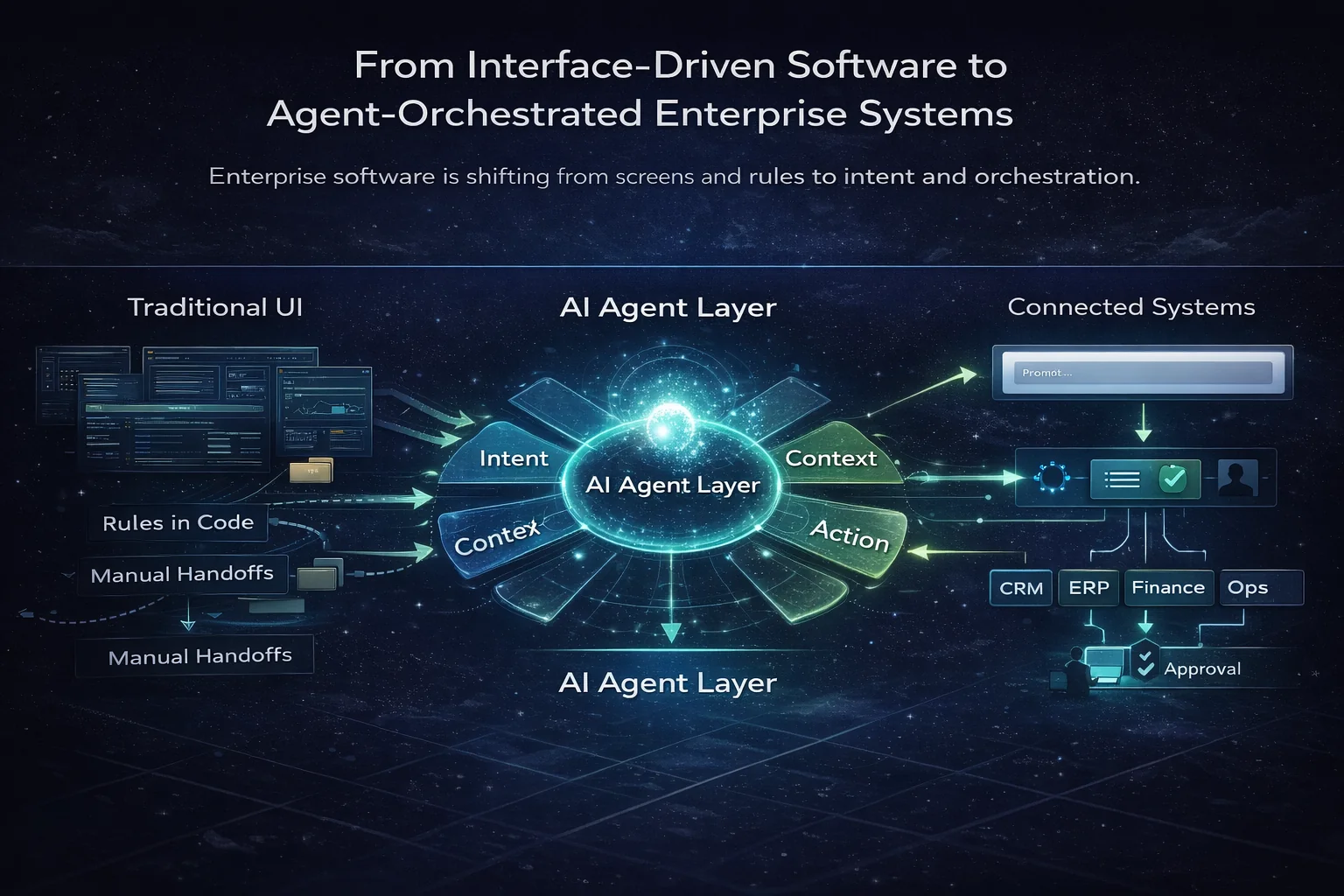
Instead of acting like a single smart interface, an agent can interpret intent, gather context, apply logic, trigger actions, and return with a result. That is a very different role from a chatbot.
Traditional enterprise software depends on structure. Menus, forms, filters, dashboards, workflows, permissions, and validation rules all exist because the user has to navigate the process manually.
That model is effective, but it is heavy.
In an agent-driven environment, some of that weight starts to disappear. The user no longer needs to know exactly where every function sits. They express an outcome, and the system handles more of the path in between.
That does not mean screens vanish entirely. Enterprise work still needs auditability, review states, controls, and visibility. But the center of gravity shifts.
The interface becomes thinner. The intent layer becomes smarter. The orchestration layer becomes more important than the menu structure.
In practical terms, that means the best enterprise products may feel less like software suites and more like controlled operating environments with a conversation layer on top.
One of the most important implications is what happens to business logic.
Today, many enterprise rules are buried in code, hard-wired workflows, or complicated configuration systems. Even a small rule change can require developer time, testing cycles, and release planning.
Agentic systems point to a different direction.
Over time, more business instructions may become readable, editable, and explainable at a higher level. Instead of treating every logic adjustment as a code problem, companies may increasingly define policies, thresholds, and actions in structured human language or governed rule templates.
That does not remove engineering from the picture. Far from it. Engineering becomes even more important because the surrounding system must stay reliable, secure, and observable.
But it does change the balance. Software becomes less about hardcoding every path and more about designing the environment in which intelligent decisions can happen safely.
There is also a strategic danger that many companies are underestimating.
If every business adopts the same off-the-shelf AI tools in the same way, differentiation starts to shrink. The workflow may become faster, but also more generic.
That matters most in areas where process quality is part of the competitive edge. Pricing logic, underwriting judgment, operational routing, compliance review, customer prioritization, supply chain handling, and decision sequencing are not just background mechanics. In many businesses, they are part of what makes the company valuable.
If those workflows are handed over entirely to generic systems, the company may save time while slowly giving up distinctiveness.
That is why the future is unlikely to be purely "buy" or purely "build." Most enterprises will use a mix. Standard tools will remain useful, but the workflows closest to differentiation, risk, or control will need more deliberate design.
One reason agentic software is different from ordinary automation is that it introduces a new design question: when should the system act alone, and when should it stop for human review?
That is not a minor UX detail. It is a core governance decision.
In some workflows, speed matters most and the system can act within clear boundaries. In others, confidence is not enough. A human checkpoint is necessary because the financial, legal, operational, or reputational stakes are too high.
The strongest enterprise AI systems will not be the ones that automate the most. They will be the ones that automate with the right control model.
That means approval layers, traceability, permissions, fallback paths, and exception handling will matter just as much as the intelligence itself.
The excitement around AI agents is real, but enterprise readiness is uneven.
The main bottleneck is not imagination. It is foundation.
Disconnected systems, weak data quality, inconsistent processes, unclear ownership, poor governance, and fragmented architecture make agentic workflows much harder to implement well. The more critical the workflow, the more dangerous it is to build on top of unreliable foundations.
This is why many companies will need to do unglamorous work before they get meaningful value from agents. Clean up key datasets. Standardize workflows. Clarify where decisions actually come from. Identify where automation is helpful and where judgment must remain visible.
Without that groundwork, AI agents become impressive demos rather than dependable operating systems.
The smartest move is not to chase every new AI product. It is to decide where intelligence can create durable business value.
Start with a few questions:
These questions lead to better priorities than simply asking where AI can be added.
AI agents are not just another software feature category.
They point toward a broader redesign of enterprise software: fewer rigid interactions, more orchestration, more dynamic logic, and more pressure to decide where human control should sit.
Some of this transition will take time. Some of it will disappoint. Some of it will be overhyped.
But the direction is still important.
The companies that benefit most will not be the ones that bolt AI onto everything. They will be the ones that redesign high-value workflows carefully, protect what makes them different, and treat control as part of the product.
That is where agentic software becomes more than hype. It becomes infrastructure for how modern enterprises operate.