

Reports exist. Dashboards exist. BI tools exist. Spreadsheets exist. But when a business question changes slightly, the workflow often becomes manual again.
A leader may start with a simple question: What was our revenue last quarter?
But the real decision usually needs follow-up questions:
Which region drove the change?
Which product category declined?
How does this compare with last year?
Can I see this as a chart?
Can I export this for a meeting?
This is where traditional reporting starts to slow down.
In our survey, we asked business and technology leaders how they work with reports, dashboards, and internal data when they need answers for decisions. The pattern was clear: dashboards are useful, but they do not always support the follow-up questions leaders ask during real business discussions.
That gap is where generative AI data analysts are becoming important. They do not replace business intelligence. They make business intelligence easier to use.
Most companies already collect more data than they can comfortably use.
Sales data sits in dashboards. Inventory movement lives in reports. Customer trends appear in spreadsheets. Operational metrics are stored across different tools. Financial summaries move through email.
The problem is not always data availability.
The problem is the distance between a business question and a usable answer.
In many organizations, business users still depend on analysts, engineers, BI teams, or spreadsheet-heavy workflows to answer follow-up questions. That dependency creates delay.
The first dashboard may show what happened. But leaders usually need to understand why it happened, where it happened, who was affected, and what should happen next.
That is where static reporting becomes limited.
In our survey, one theme came up repeatedly: business teams are not looking for more dashboards for the sake of dashboards.
They want faster access to answers.
Many leaders already have reporting systems. But when they need to ask the next question, the process often becomes slower than expected.
The survey showed three common patterns.
First, leaders want answers during the decision window, not after the meeting has passed.
Second, dashboards are helpful for standard reporting, but less helpful when the question changes.
Third, business users want outputs they can immediately use, such as charts, tables, Excel files, and presentation-ready summaries.
This is why generative AI data analysts are more than another chatbot interface. They are a new way to make business intelligence more conversational, faster, and more usable.
Our survey showed that the biggest analytics frustration is not always missing data. It is the time and dependency involved in getting follow-up answers.
Business users often need analysts, engineers, BI teams, or manual spreadsheet work to move from the first question to the real insight.
A generative AI data analyst reduces this gap by letting users ask business questions in plain English and continue the analysis through follow-up questions.
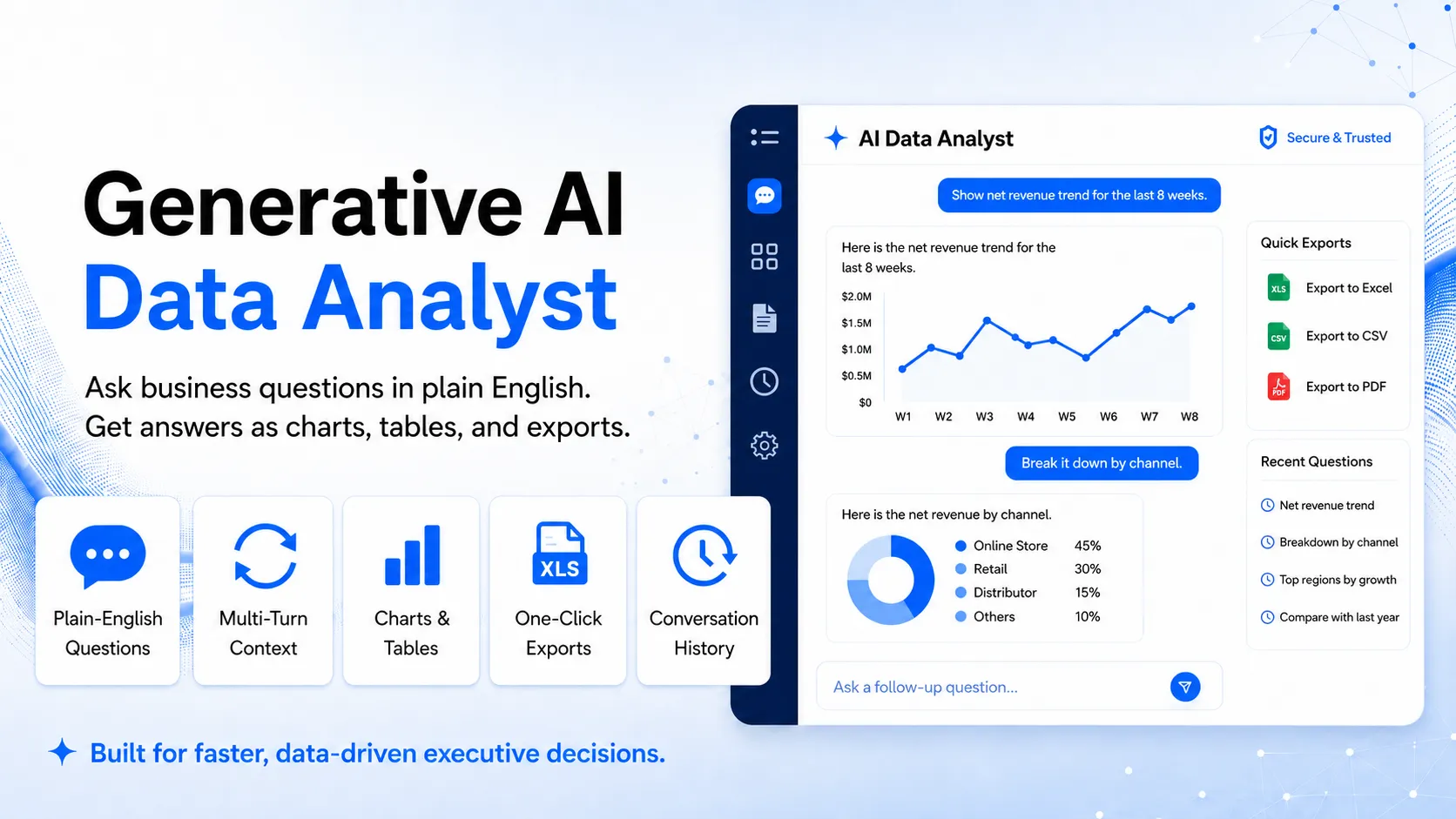
A generative AI data analyst is an AI-powered business application that lets users explore company data through natural language. Instead of navigating filters, dashboards, queries, and exports manually, users can ask questions in plain English.
For example:
Show weekly net revenue for the last eight weeks.
Segment this by channel.
Rank channels by total revenue.
Compare the top two channels for the last four weeks.
Export this as Excel.
The system understands the business question, connects it to approved data sources, runs the analysis, and presents the result in a usable format. That output may be a chart, table, summary, CSV file, Excel file, or PDF.
The goal is not to make users learn the tool. The goal is to let users ask the question the way they naturally think about the business.
Dashboards are useful when the question is already known.
They work well for recurring views such as:
But real business conversations are not always predictable.
A dashboard may answer: What happened?
But leaders often need to ask:
That is where the dashboard experience often becomes fragmented.
The user must switch filters, export data, open spreadsheets, request help, or wait for another report.
A generative AI data analyst makes that experience conversational.
The user can continue asking follow-up questions without starting over.
The biggest advantage of a generative AI data analyst is not the first answer. It is the follow-up. Business analysis usually happens as a chain of questions.
A sales leader may begin with:
Show revenue trend for the last six months.
Then: Break this down by region.
Then: Which region had the highest growth?
Then: Show that as a bar chart.
Then: Export this to Excel.
The leader does not need to repeat the original context every time. The AI understands the thread and continues the analysis. That changes the speed of decision-making. Instead of waiting for another report, the user can refine the analysis in the moment.
A business answer is only useful if the user can work with it. Text alone is not enough. Business users need outputs that can move into meetings, reports, presentations, and decision documents.
A strong AI data analyst should support:
This matters because many business decisions do not happen inside the analytics tool. They happen in review meetings, leadership discussions, planning calls, and presentations. The AI analyst should reduce copy-paste work, not create more of it.
Sales teams can explore revenue movement, product performance, regional trends, customer contribution, and pipeline risk.
Example question: Which regions had the strongest revenue growth this quarter?
Finance teams can review margin movement, forecast variance, cost trends, revenue summaries, and monthly performance.
Example question: Compare gross margin by business unit for the last four quarters.
Operations teams can track inventory, production output, service levels, delivery performance, and bottlenecks.
Example question: Which product categories have the highest delay risk this month?
Executives can ask strategic questions without waiting for manual report preparation.
Example question: What changed most significantly in business performance this month?
Customer teams can identify retention risks, service trends, account performance, and growth opportunities.
Example question: Which customer segments show declining engagement?
The value is not limited to one department. Any team that depends on data can benefit from faster question-answer workflows.
A simple AI demo can answer a few questions. An enterprise-ready AI data analyst must do much more. It needs strong product design, reliable backend systems, secure data access, and clear governance. Important capabilities include:
Without these foundations, the system can become risky. It may answer from incomplete data. It may expose information to the wrong user. It may use inconsistent KPI definitions. It may produce confident responses when the data is not reliable. For business-critical analytics, trust matters as much as intelligence.
Generative AI can make analytics faster, but speed is not enough. The system must also be accurate, secure, and explainable. Without governance, companies may face problems such as:
This is why AI analytics should not be treated as a chatbot pasted on top of dashboards. It should be designed as a secure business application. The best systems combine AI with strong data architecture, permissions, business definitions, logging, and user experience.
Score each question from 1 to 5.
1 = Not true today
5 = Strongly true today
8–18: Foundation First
Your company may need to improve dashboards, data access, KPI definitions, and reporting foundations before introducing an AI data analyst.
19–30: Pilot Ready
Your company may be ready for a focused AI data analyst pilot around one department, one dataset, or one decision workflow.
31–40: Scale Opportunity
Your company may be ready to build a broader conversational analytics product with secure access, multi-turn analysis, exports, and governance.
At AblyCode, we design, build, and scale custom software products with startup agility and enterprise reliability. We work across full-cycle software development, SaaS development, application modernization, API development, software integration, digital transformation, generative AI development, and dedicated teams.
A generative AI data analyst is not only an AI prompt box. It requires a complete product approach:
When these parts work together, companies can move from static reporting to interactive decision-making. That is the real opportunity. Not just faster answers. Better decisions, with less friction.
Business data should not be difficult to access. Leaders should be able to ask direct questions and get clear answers. Teams should be able to move from a high-level number to a deeper insight without waiting days for manual reporting.
Generative AI data analysts make this possible. They turn dashboards into conversations, reduce manual analysis work, and help teams make faster, better-informed decisions. For companies that rely on data but still spend too much time preparing reports, this is one of the most practical uses of generative AI in business today.
AblyCode helps companies design, build, and scale secure AI-powered software products, dashboards, SaaS platforms, and data-driven business tools.