

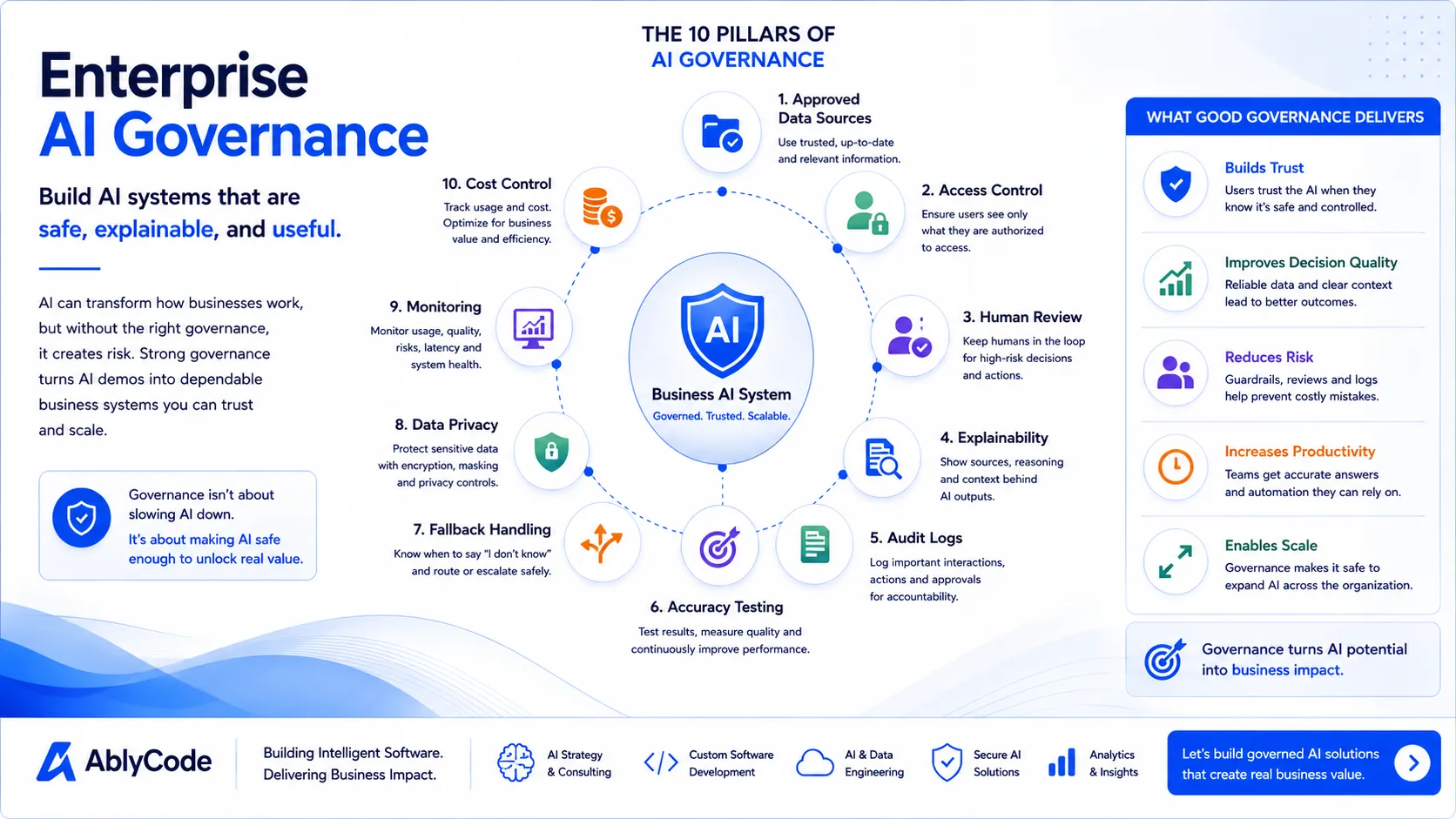
Generative AI is easy to demo.
It is much harder to trust in production.
A chatbot can answer questions in a meeting. An AI assistant can summarize a document. An AI agent can prepare a workflow. An AI data analyst can generate a chart. These examples look impressive when the scope is small and the data is controlled.
But enterprise AI is different.
In a real business environment, AI may interact with customer data, financial information, internal documents, sales metrics, contracts, operational workflows, employee information, and sensitive decisions.
That changes the question.
The question is no longer only:
Can AI produce a useful answer?
The better question is:
Can the business trust the AI system to work safely, consistently, and within clear boundaries?
That is where enterprise AI governance becomes important.
AI governance is not about slowing innovation. It is about making AI reliable enough to use in real workflows.
Without governance, AI remains a demo.
With governance, AI can become a dependable business system.
Many businesses hear the word governance and think about policies, audits, risk teams, and compliance documents.
Those things matter, but AI governance is broader than that.
Good AI governance answers practical product and engineering questions:
These are not abstract questions. They directly affect whether the AI system can be used safely by employees, customers, managers, and decision-makers.
Enterprise AI governance is really about control.
It defines how AI should behave inside the business.
Traditional software usually behaves in predictable ways.
A button triggers a known action. A form validates fixed fields. A workflow follows defined rules. A report pulls data from a known query.
AI systems behave differently.
They generate outputs.
They interpret natural language.
They may summarize information.
They may retrieve documents.
They may recommend next steps.
They may use tools.
They may create content that sounds confident even when the source information is incomplete.
This flexibility is what makes AI powerful.
It is also what makes governance necessary.
A business AI system should not be allowed to answer every question, access every file, or take every action simply because the model can generate a response.
The system needs boundaries.
Those boundaries must be designed into the product.
AI should not answer from random or uncontrolled information.
In business applications, the quality of the answer depends heavily on the quality of the source.
A knowledge assistant should answer from approved documents.
An AI data analyst should use trusted metrics.
A document intelligence tool should use the uploaded document and defined extraction rules.
An AI agent should use the systems and APIs it is allowed to access.
Without approved sources, the AI may mix outdated information, unofficial documents, incomplete records, or irrelevant content into its response.
That creates risk.
Good AI governance starts by defining source ownership.
Businesses should ask:
The AI system should be connected to trusted information, not just available information.
AI systems must respect permissions.
If a user cannot access a document, dashboard, customer record, or financial report through normal systems, they should not be able to access it through AI.
This sounds obvious, but it is one of the most important enterprise AI risks.
A poorly designed AI assistant can become an accidental shortcut around permissions.
For example:
Enterprise AI systems need role-based access control, document-level permissions, data filtering, and user-aware retrieval.
The AI should not only understand the question.
It should understand who is asking.
Not every AI output should become an automatic action.
Some workflows are low-risk.
For example, summarizing a public document, drafting an internal note, or classifying a low-priority support ticket may be safe enough with limited review.
Other workflows need human approval.
For example:
The right governance model defines when AI can act, when it can recommend, and when it must stop for review.
This is especially important for AI agents.
An AI agent that only prepares a recommendation carries less risk than one that updates systems automatically.
The best enterprise AI systems do not automate everything.
They automate with the right control model.
Business users need to understand why an AI system produced an answer.
That does not mean every model decision needs a highly technical explanation.
But the system should provide enough context for users to evaluate the result.
For example, an AI data analyst should show the metric used, the filter applied, and the source of the data.
A knowledge assistant should show which document or policy supported the answer.
A document intelligence tool should show which section of the document was used.
An AI agent should show which steps it followed before recommending an action.
Explainability creates trust.
It also helps users catch mistakes.
If the AI answer appears without source context, users may either trust it too much or reject it completely.
Neither outcome is good.
Enterprise AI needs transparency that is useful to real users.
Every important AI interaction should be traceable.
Audit logs help businesses understand what happened, who asked, what data was accessed, what answer was generated, and what action was taken.
This matters for debugging, compliance, security, and trust.
An AI system should log:
Logs become especially important when AI systems interact with business workflows.
If an AI agent routes a request, drafts a response, updates a record, or recommends an action, the business should be able to review that path later.
No important AI action should disappear into a black box.
AI systems should be tested before and after launch.
A few successful demo questions are not enough.
Businesses need evaluation sets.
For a knowledge assistant, the team should test whether the AI retrieves the right documents and answers correctly.
For an AI data analyst, the team should test whether the numbers match trusted reports.
For document intelligence, the team should test extraction accuracy across different document formats.
For AI agents, the team should test whether the agent follows boundaries and stops when human review is required.
Testing should include failure cases.
What happens when the answer is not available?
What happens when sources conflict?
What happens when the user asks for restricted data?
What happens when the document is incomplete?
What happens when the system is unsure?
A reliable AI system must know how to fail safely.
AI will not always have the answer.
That is normal.
The problem is not that AI sometimes fails. The problem is when it fails confidently.
Enterprise AI systems need fallback behavior.
The system should be able to say:
The system should not invent answers to fill gaps.
Fallback handling protects users from false confidence.
It also makes the AI product feel more trustworthy.
A good AI system does not pretend to know everything.
It knows when to stop.
AI systems may process sensitive information.
That can include customer records, contracts, invoices, employee data, sales performance, financial figures, product strategy, medical information, legal documents, or internal communications.
Businesses must decide how this data is handled.
Important questions include:
Privacy decisions should be made before launch, not after something goes wrong.
Enterprise AI governance should define how sensitive information moves through the system.
AI usage has ongoing cost.
Every request may involve tokens, retrieval, file processing, tool calls, image processing, audio processing, or model usage.
Without monitoring, cost can grow unexpectedly.
Enterprise AI governance should include cost controls such as:
Cost does not mean AI should be avoided.
It means AI should be measured.
A business should know which AI workflows create value and which ones only create usage.
AI systems need monitoring after launch.
Business data changes.
Users ask new questions.
Documents become outdated.
Workflows evolve.
Models change.
Integration behavior changes.
Costs shift.
Security needs change.
A production AI system should be monitored for:
Monitoring turns AI from a one-time project into an improving business product.
Governance cannot be added only as a policy document.
It must be built into the software.
Access control should be part of the architecture.
Human review should be part of the workflow.
Source visibility should be part of the interface.
Audit logs should be part of the backend.
Cost monitoring should be part of operations.
Fallback handling should be part of the user experience.
This is why enterprise AI is a software product challenge, not only an AI model challenge.
The model generates intelligence.
The product controls how that intelligence is used.
More data does not always mean better AI.
If the system retrieves from too many uncontrolled sources, answer quality may decrease and privacy risk may increase.
Start with approved, high-value sources.
If permissions are ignored, AI can expose sensitive information.
Every AI system should respect user access levels.
For risky workflows, human review is essential.
The system should make review easy, not bypass it.
Testing only successful examples creates false confidence.
A reliable AI system must be tested against missing, conflicting, restricted, and ambiguous information.
Without logs, businesses cannot understand what happened.
Logs are necessary for debugging, accountability, and trust.
Every AI system needs an owner after launch.
Someone must monitor performance, update sources, review feedback, and improve the system.
Before launching an enterprise AI system, ask:
If these questions are unclear, the AI system is not ready for serious business use.
A safe enterprise AI system should feel useful, but controlled.
For example, an AI data analyst should answer from approved business metrics, show chart or table outputs, respect permissions, and explain when data is incomplete.
A knowledge assistant should cite approved documents, avoid restricted sources, and say when it cannot find a reliable answer.
A document intelligence tool should extract information, show confidence, highlight source sections, and send high-risk items for review.
An AI agent should recommend actions, follow rules, log every step, and ask for approval before taking sensitive actions.
Safe AI is not weak AI.
Safe AI is AI that a business can actually rely on.
At AblyCode, we build AI systems as secure business applications, not just model demos.
Our approach focuses on the full product around the AI.
That includes:
We help businesses build AI data analysts, knowledge assistants, workflow automation tools, document intelligence systems, customer portal assistants, and AI-powered SaaS features.
The goal is not to make AI look impressive in a demo.
The goal is to make AI useful, safe, explainable, and maintainable in real business operations.
Enterprise AI does not become valuable because it can generate answers.
It becomes valuable when people can trust those answers.
That trust comes from governance.
Approved data sources.
Access control.
Human review.
Audit logs.
Explainability.
Accuracy testing.
Fallback handling.
Privacy protection.
Monitoring.
Cost control.
These foundations turn AI from an experiment into a dependable business system.
The companies that win with AI will not be the ones that automate blindly.
They will be the ones that design AI carefully, protect users and data, and build systems that are safe enough to scale.
AblyCode helps companies design and build secure AI data analysts, AI agents, knowledge assistants, workflow automation tools, and AI-powered SaaS systems with the right governance from the start.